
From a kayak, a bike trail, or a riverfront path, the first look is usually too brief to be satisfying. A brown head appears near shore, a narrow wake trails behind it, and the animal keeps moving until it slips under or disappears against the bank.
Beaver is an easy guess. Otter is another. Along the Fox River in northern Illinois, though, there is a good chance the animal is a muskrat, a common native mammal whose life is tied far more closely to the first few feet of shoreline than its occasional appearance in open water suggests.
Muskrats are firmly part of the local landscape. Illinois records place them statewide and especially commonly in the northern part of the state, and Kane County evidence puts them in the Fox River corridor and nearby wetlands.
Most of the House Is Underground
The familiar picture of a muskrat house is a mound of cattails and other vegetation rising above a marsh. Muskrats certainly build those lodges, especially in shallow wetlands with stable water levels, but that image can be misleading on a river. Illinois wildlife guidance notes that muskrats in streams, rivers, lakes, and ponds commonly excavate dens directly into the bank, and that bank-dwelling muskrats are more common in the state than lodge-builders.
The entrance is usually underwater. From there, a tunnel rises into the bank to a chamber above the normal waterline, where the animal can rest, shelter, and rear young without having to expose itself on shore. A bank may contain more than one entrance, and the same muskrat may use several burrows along its home range. Muskrats also develop underwater travel routes between important places. In marshes those routes can become obvious channels through vegetation. Along a river, much of the same architecture can remain almost invisible from above.
That changes the meaning of a routine sighting. When a muskrat swims steadily beside a bank and then vanishes at the waterline, it may not have left the area at all. It may have entered a submerged doorway. The animal that seemed to be traveling downriver may have been moving through a neighborhood whose rooms are buried in the shoreline.
A Life Measured in Shoreline
One of the best glimpses into that hidden life comes from University of Illinois researchers who radio-tracked muskrats in small streams and agricultural drainage channels in east-central Illinois. The habitat was different from the main Fox River. However, the pattern of movement is revealing.
The tracked muskrats lived in long, narrow home ranges that followed the stream bank. Adults averaged about 804 meters of linear shoreline and juveniles about 529 meters, with the combined average at 582 meters. Individual animals used an average of roughly seven bank burrows, with some using as few as three and others as many as thirteen. Most movement was concentrated around those established burrows rather than spread evenly across the available stream.
Ecologists describe that pattern as multiple central-place foraging, a technical term for a fairly intuitive arrangement. A muskrat has several places where it can retreat, rest, and operate from, and much of its movement occurs between those places and nearby feeding areas. Its home range stretches along the bank rather than spreading broadly across the surrounding landscape.
That helps explain why the animal so often seems glued to the shoreline. Open water may be the easiest place for us to see it, but open water is not necessarily the center of its life. The important geography is the bank itself: a submerged entrance here, a stand of vegetation there, a protected corner, another burrow farther along. Even in a heavily altered Illinois stream, the research showed muskrats using this narrow strip with considerable fidelity.
What It Is Doing When You See It
Muskrats are primarily plant eaters. In Illinois they feed on cattails, bulrushes, sedges, water lilies, smartweeds, American lotus, and other aquatic or shoreline vegetation, taking animal food such as crayfish, mussels, or other small aquatic prey only occasionally. The exact menu on a given stretch of the Fox depends on what is growing there, which is one reason backwaters, sloughs, marshy margins, and vegetated shorelines can be more important to a muskrat than a visually impressive stretch of open channel.
A swimming muskrat may be moving from a burrow to a feeding site, from one burrow to another, or back toward cover after feeding. An animal carrying vegetation may be transporting food, lodge material, or both. A muskrat that repeatedly disappears at the same point on a bank gives a stronger clue: the place deserves another look for a submerged entrance, a worn run, clipped vegetation, or other sign.
Most muskrat activity occurs from evening through the night, but daylight sightings are not unusual, particularly around dawn and dusk and during parts of the breeding season. They remain active through winter rather than hibernating. Young animals also disperse, especially during seasonal periods when they are establishing new home ranges, so not every muskrat seen moving along the river is necessarily operating inside an established local circuit.
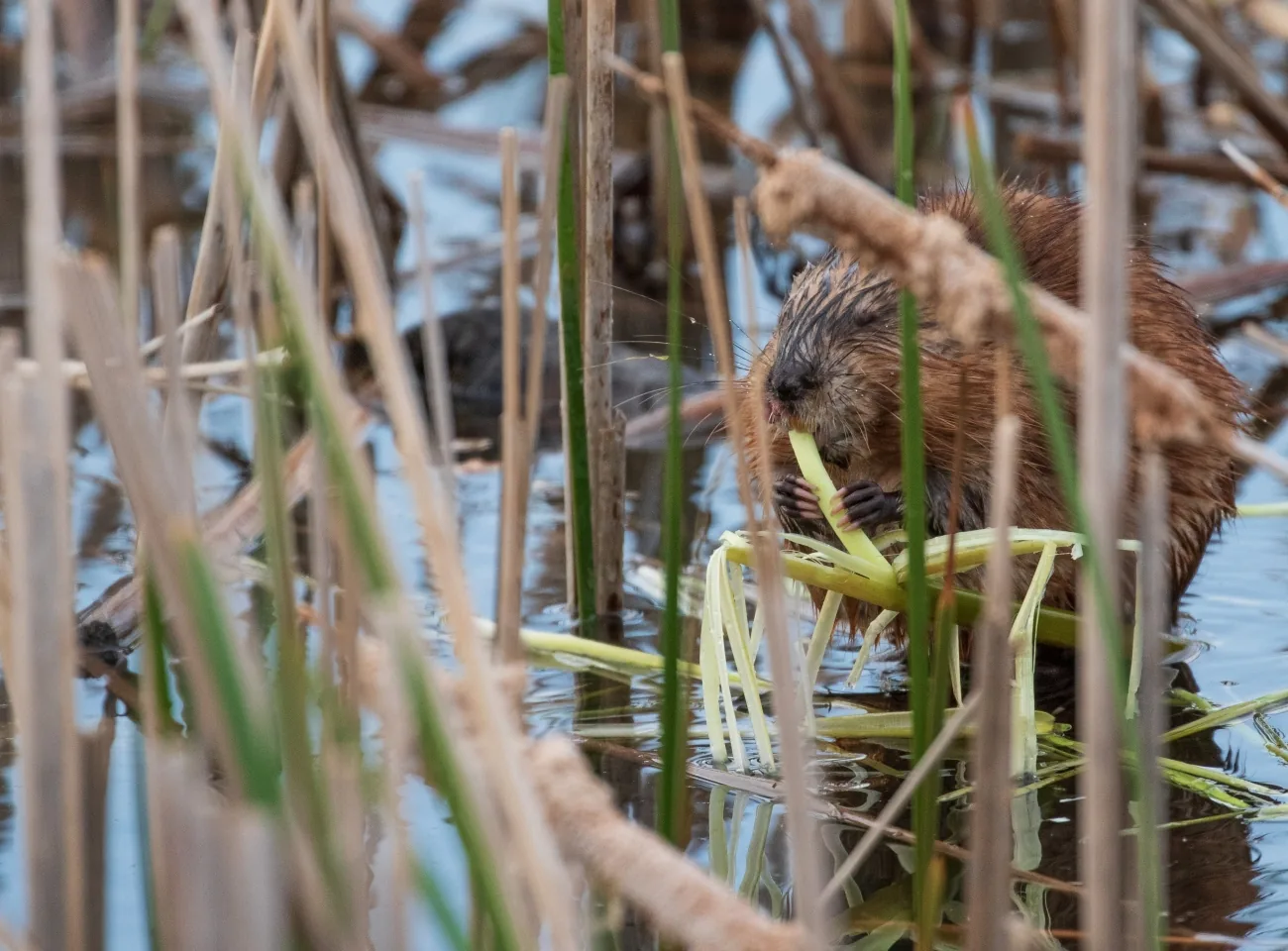
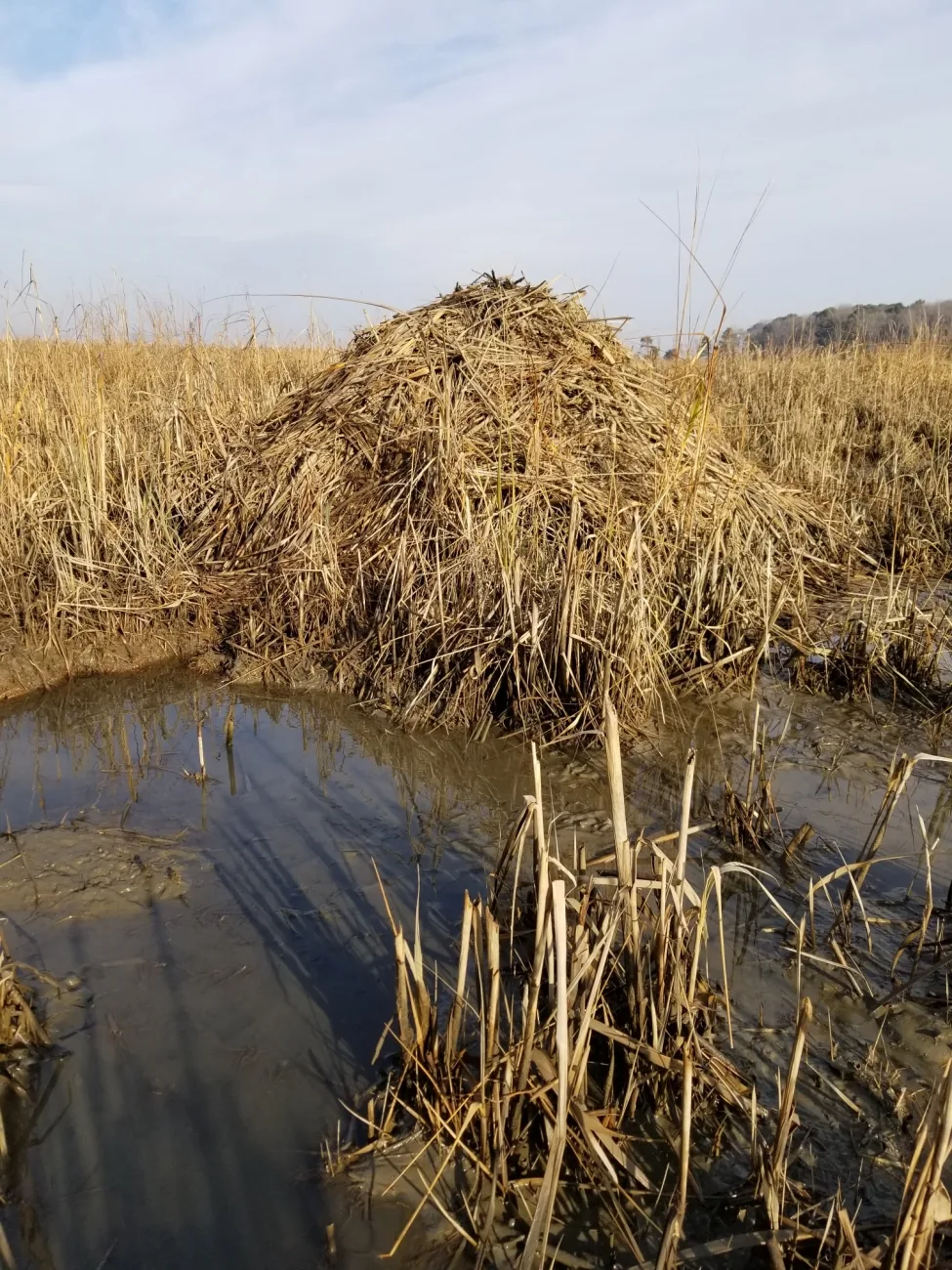
Muskrat, Beaver, Mink, or Otter?
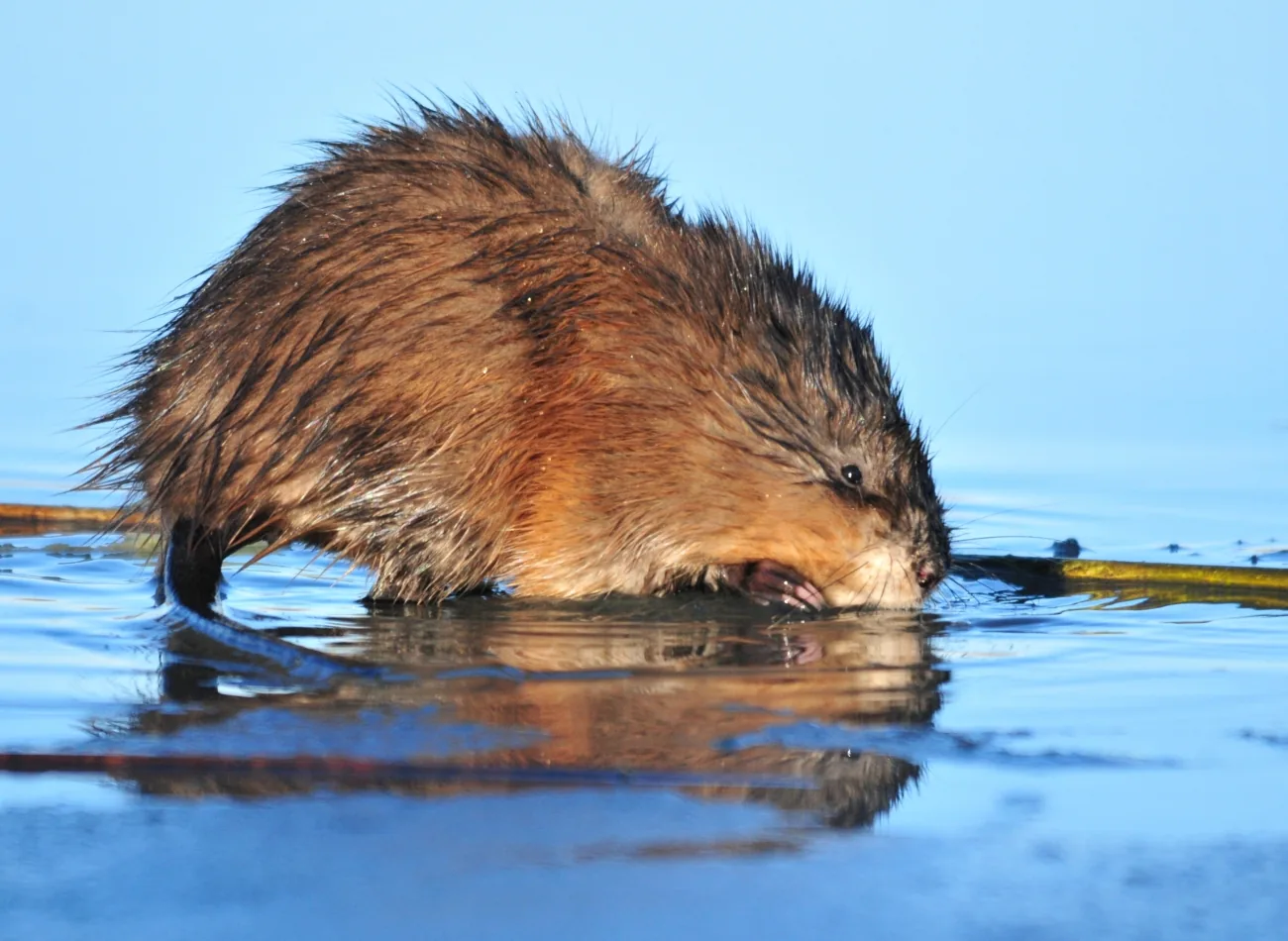
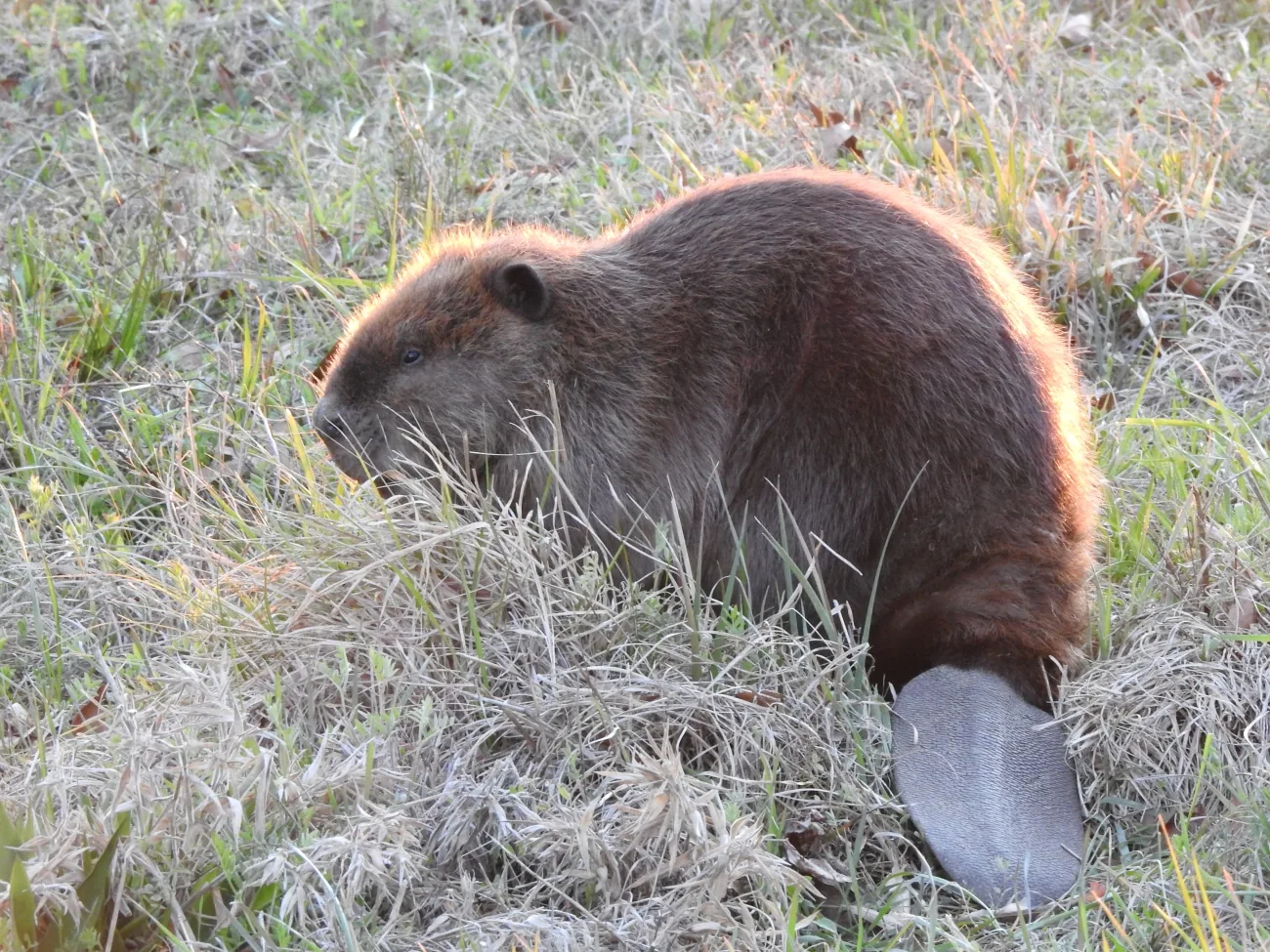
Muskrats and beavers are both semi-aquatic rodents with brown fur, but the similarity becomes less convincing once scale and shape are visible. An adult Illinois beaver commonly weighs 25 to 60 pounds and can reach three to three and a half feet in length. A muskrat is closer to two feet from nose to tail. In good light, the tail settles the question quickly: a beaver carries the familiar broad, leathery paddle, while a muskrat has a long, narrow, nearly hairless tail flattened from side to side.
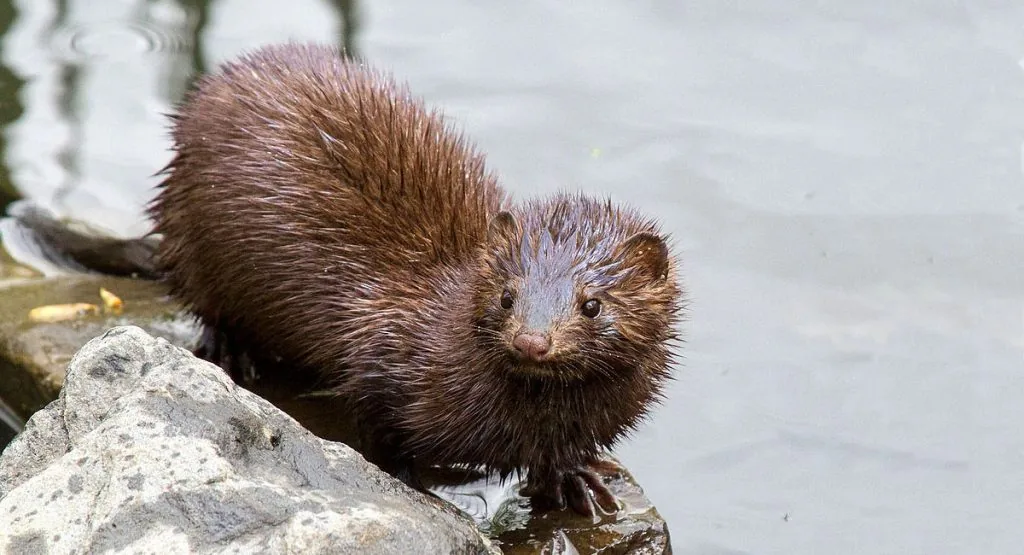
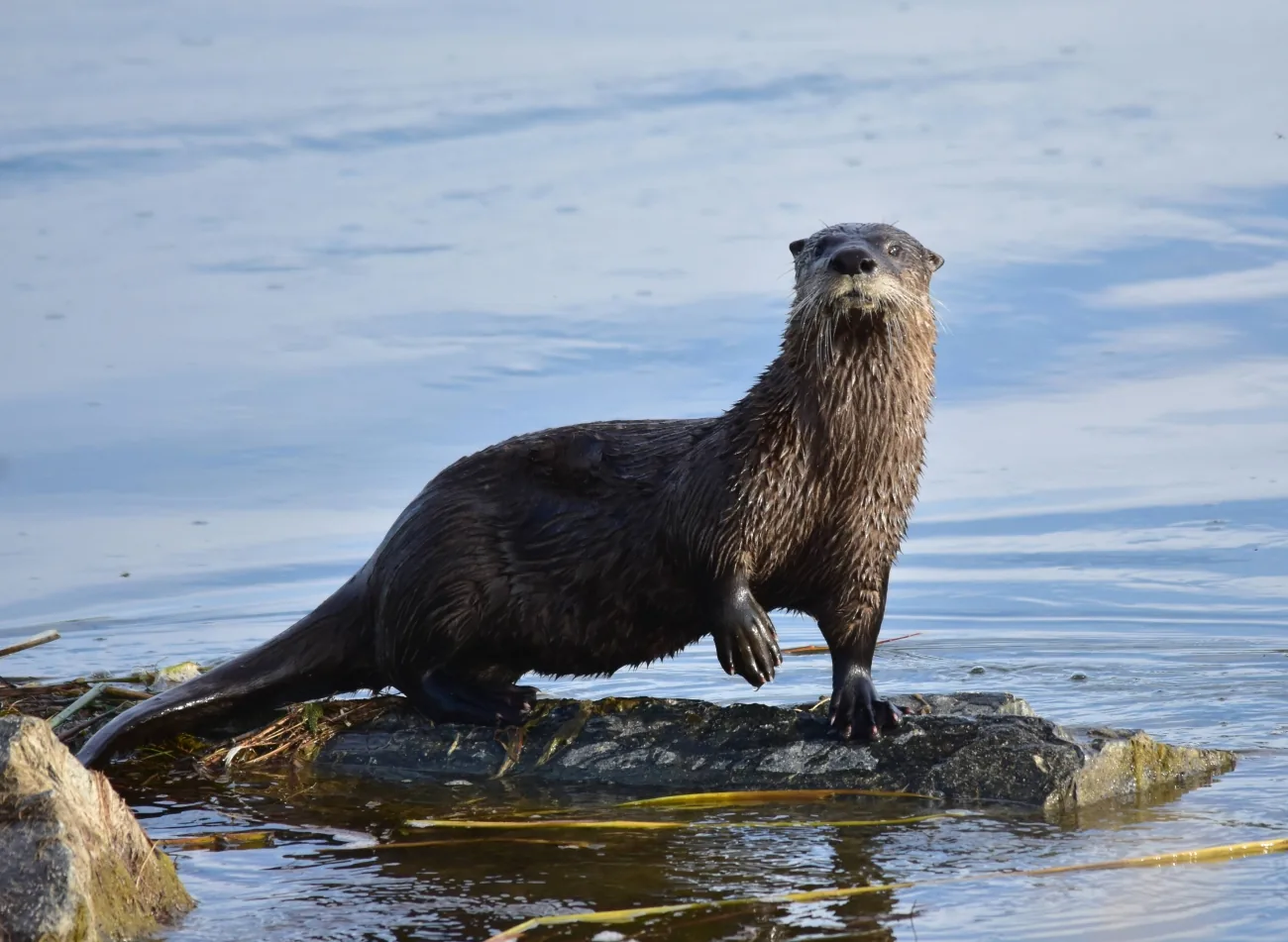
The harder comparisons can be mink and, at greater distance, river otter. Mink overlap the muskrat more closely in overall length, but the body is long and weasel-like rather than compact, and the tail is fully furred and tapered. River otters are much larger, longer through the neck and body, and built for extended swimming and repeated diving. Surface conditions can make all of these distinctions harder than a field guide suggests, which is why no single wake shape should carry an identification by itself.
| Comparison | Muskrat | Beaver | Mink | River otter |
|---|---|---|---|---|
| Image |
|
|
|
|
| Scale | About 18–25 in. total | About 3–3½ ft.; commonly 25–60 lb | Roughly 17–26 in. total | About 34–53 in.; 10–30 lb |
| Surface profile / swimming | Compact and rounded; the head looks large for the body. Often rides close to the surface near shore; part of the back may show depending on speed. | Much bulkier; the head looks relatively small on a heavy body. Smooth, low swim with more mass behind the head. | Long, low, weasel-shaped; often more of the back shows. Quick, direct swimmer that frequently moves in and out of shoreline cover. | Longer, heavier, thick-necked. Often the head and neck dominate at the surface, followed by repeated dives and long underwater runs. |
| Tail | Long, narrow, nearly hairless, and flattened side-to-side. May trail visibly or scull just under the surface. | Broad, flat, leathery paddle; often submerged while swimming, unmistakable when seen. | Fully furred, tapered, and darker toward the tip. | Thick, fully furred, muscular, tapering to the tip. |
| Behavior & context | Usually tight to bank, vegetation, sloughs, or backwaters. May carry plants and disappear into submerged bank entrances. | Chewed woody stems, slides, bank dens, dams, or lodges. Juveniles can confuse size at distance. | Hunts along rocks, roots, and banks; alternates readily between land and water. | More aquatic and wide-ranging; may surface well off bank or appear in pairs or family groups. |
Wake can help, but it belongs near the bottom of the checklist. Speed, current, wind, chop, viewing angle, and whether the animal has just surfaced can all change the shape of the disturbance behind it. Size, proportion, tail, swimming posture, behavior, and where the animal appears are more reliable when several of them point in the same direction.
A Suburban River Animal
The Fox River is an odd kind of wildlife corridor. In places the river runs behind homes, parks, bike trails, roads, restaurants, bridges, and downtown blocks. A few bends later, the bank may be wooded, wet, or difficult to reach. It is neither an intact wilderness river nor a fully engineered urban channel, and that mixed character matters to muskrats.
Research from east-central Illinois suggests that muskrats can tolerate more human alteration than their marsh-dwelling image might imply. In a study of ninety stream segments, muskrat occupancy was positively associated with surrounding urban land cover. They were also found more often in larger, deeper streams with substantial banks and less sandy bank soil. The researchers did not conclude that development itself is good for muskrats. They suggested that urbanized streams may sometimes offer higher base flows or reduced exposure to trapping and some predators, and they emphasized the importance of connected riparian habitat.
Another Illinois study found that muskrat survival in altered streams increased with the width of the riparian buffer. In other words, tolerance for development does not make the edge irrelevant. The shoreline still has to work.
A muskrat does not need the nearest parking lot, bike trail, or house to disappear. It needs usable water, places to feed, a bank it can occupy, and enough connected edge to move through its daily range. Some development can sit surprisingly close to that system. Other forms of development, such as extensive bank armoring or the removal of shoreline vegetation, can eliminate parts of it even when the river itself remains open.
The result is a mammal that can live in a landscape people may not think of as particularly wild. The animal disappears because it is secretive, because much of its shelter is underground, and because the riverbank looks ordinary until there is a reason to inspect it more carefully.
What Muskrats Change
A muskrat is much smaller than a beaver and does not reorganize a river with dams, but its presence still leaves physical traces. Feeding removes vegetation, burrowing alters the bank, and repeated travel can cut narrow runs through dense plants. Lodges and feeding platforms, where they occur, provide structure that other animals can use. Even an abandoned bank burrow may remain useful after the muskrat leaves; mink are among the animals that can take over those shelters.
In the University of Illinois telemetry work, mink caused most of the documented muskrat mortalities, usually along stream edges during ordinary, non-flood conditions. That relationship is strong enough that other Illinois research has found mink occupancy linked to the presence of muskrats. A muskrat burrow, feeding run, or regular shoreline route therefore matters to more than the animal that made it. The same narrow strip of bank can be home range, feeding ground, refuge, and hunting ground depending on which animal is using it.
Muskrats also live in a difficult physical position. Their dens depend on a relationship between bank height and water level, while floods can displace them from the very burrows that provide safety. Water that drops too far can expose entrances and reduce access to feeding habitat. Water that rises sharply can fill chambers or force animals onto land. The edge works because it sits between water and dry ground, and that same position makes it vulnerable to changes in both.
The next time a small brown animal appears beside a Fox River bank, watch the size and shape first. Look for the long, narrow tail rather than a beaver's paddle, the compact body rather than a mink's stretched profile, and the smaller scale and steadier shoreline travel that separate it from an otter.
Then keep watching after the identification is settled. Notice whether the animal stays tight to shore, whether it dives at the same place twice, whether vegetation has been clipped nearby, or whether a faint channel leads into a patch of emergent plants. The muskrat on the surface is only the part of the animal's life that happens to be visible. Much of the rest is built into the river's edge.