
Crayfish feed the river and feed on it, shed their armor to grow, and have been quietly rearranged by the arrival of an invasive species.
Turn over the right rock in shallow water and a crayfish seems almost inevitable. It may remain still for a moment, claws raised toward the sudden light, before backing into another crevice or snapping its tail and disappearing through the water. The encounter is so familiar that there is little reason to wonder what kind of crayfish it was. For most of us, a crayfish is simply a crayfish.
Illinois surveys have documented seven kinds of crayfish across the watershed, from animals associated with rocky current to species that prefer sluggish, vegetated water and others that spend much of their lives in burrows beneath wet ground. Three deserve particular attention in the Fox's faster, rockier reaches: two native species, the Virile Crayfish and Northern Clearwater Crayfish, and the nonnative Rusty Crayfish, which has spread through the watershed during the past half century. Their ranges and habitats overlap, but they are not interchangeable. Even beneath a seemingly ordinary stretch of Fox River rock, the species present can tell us something about the water around them and, increasingly, about how the river's animal community has changed.
Crayfish also occupy a more important ecological position than their familiar role as fishing bait suggests. They graze algae, consume plants, break down dead organic material, prey on smaller animals, move sediment, compete for shelter and become food for fish, birds and mammals. For several days or weeks of the year, depending on age and species, they undergo an especially dramatic transformation in order to grow: the hard external skeleton that protects them must be abandoned and rebuilt.
The animal beneath the rock turns out to be connected to a great deal of what is happening on the Fox River.
Several Kinds of Crayfish
In the Fox's rockier, moving-water habitat, the three species most likely to overlap are the Virile Crayfish, Northern Clearwater Crayfish and Rusty Crayfish. The Virile Crayfish is one of Illinois' most widespread native crayfish and occurs in creeks, rivers and lake margins, frequently using rocks as shelter. It is a substantial animal with broad claws, often brown or olive in color, although appearance varies enough that color alone is a poor identification method. The Northern Clearwater Crayfish is more closely associated with clean, rocky streams and riffles. Its claws often end in conspicuous orange or red tips with a dark band behind them. Rusty Crayfish also favor rock and gravel and can closely resemble the native species at a casual glance. The familiar rusty patches on either side of the shell are useful when they are distinct, but even those markings vary.
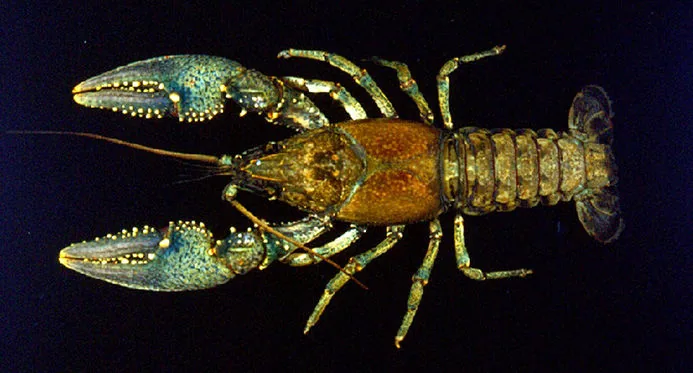
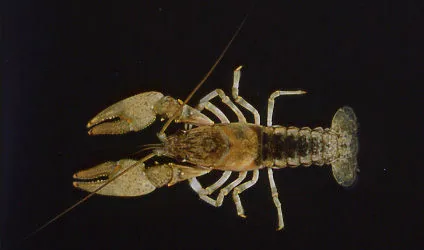
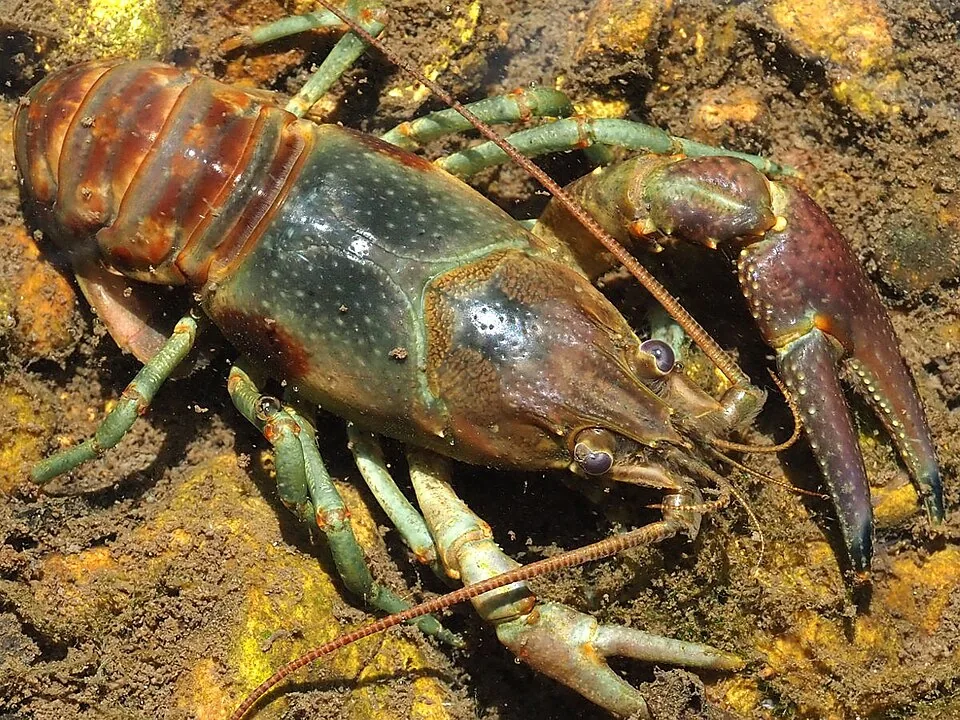
That similarity in habitat is ecologically important. A large rock is more than an object resting on the riverbed. The void beneath it and the spaces among neighboring stones create refuge from current and from predators. A crayfish small enough to retreat deeply into cobble can become difficult for a bass, heron or mink to reach. Shelter also provides somewhere to remain during daylight and during the particularly vulnerable period around molting. For crayfish occupying moving water, the geometry beneath the stones can matter as much as the stones themselves. The same interstitial spaces that make rock useful fish habitat also shape the lives of the prey living inside it.
Other crayfish in the Fox watershed occupy rather different worlds. Calico Crayfish, also called Papershell Crayfish, tolerate sluggish water, softer bottoms, plant debris and vegetation. White River Crayfish likewise use slower water and can retreat into burrows during low-water periods. Devil Crayfish and Prairie Crayfish push the distinction even farther. They are accomplished burrowers, capable of spending long periods beneath wet soils associated with floodplains, ponds, wetlands and stream margins.
The result is a watershed in which "crayfish habitat" can mean a rocky run, a vegetated backwater, a muddy pool or a burrow whose occupant may scarcely be visible from the surface. The rock-turning crayfish is real, but it is only one version of the animal.
The Fox itself changes character from north to south. Above Algonquin, the Illinois mainstem is very low-gradient, with slower, deeper, more lake-like water. Below Algonquin, the channel becomes steeper through much of the middle river, and its free-flowing sections contain more riffle-and-run habitat before the river flattens again farther downstream. Tributaries add still more variation. That range of current, depth and habitat helps explain how one watershed can support crayfish with such different requirements.
A Life Built Around Shelter
For a crayfish living among rocks, much of daily life involves deciding when it is safe to leave shelter. Daylight observations often find crayfish tucked beneath stones, inside crevices or in shallow excavations. Darkness changes the balance. Field studies of a widespread native species have found animals that were difficult to see during the day moving openly across stream bottom after nightfall, sometimes in surprisingly high numbers. Food becomes accessible beyond the immediate shelter, other crayfish are moving, and reproductive activity may require travel.
Calling crayfish nocturnal is still too simple. Predators alter the calculation. Experiments with Northern Clearwater Crayfish exposed to smallmouth bass found the crayfish using more protective substrate, walking and feeding less, and devoting more behavior to defense and concealment. What looks from above like a daily schedule is really an ongoing tradeoff: leaving refuge offers food, mates and access to new habitat, but it also makes an animal easier to find.
Current and water level add another set of constraints. A crayfish crawling through slow water expends little energy simply remaining in place; the same animal exposed on a fast streambed has to work against the current while trying to feed. Experiments with Rusty Crayfish have found that sufficiently strong current can reduce feeding performance. The spaces beneath and behind rocks create small areas where current can be dramatically weaker than it is a few inches above the riverbed. Water level can rearrange those shelters as well: a stone that offers excellent refuge beneath a foot of water can become shoreline after a falling river.
Cold water changes activity without creating a clean biological cutoff. Metabolism falls, movement generally declines, and some species become relatively inactive. Some crayfish concentrate in deeper water and beneath rock as temperatures fall, while Rusty Crayfish tolerate a wide range of temperatures and adjust seasonally. At the other extreme, crayfish facing unusually warm water have been observed moving or excavating into cooler refuges. There is no single temperature at which the crayfish of the Fox River switch off; species, habitat and immediate conditions keep changing the answer.
Growing Out of Their Armor
A crayfish's most obvious defense creates one of the central problems of being a crayfish: the hard exoskeleton surrounding the animal cannot expand indefinitely. Growth therefore requires the crayfish to periodically dismantle part of that armor, crawl out of it and construct another.
Preparation begins before the old shell is shed. Studies of one common native Fox species show that calcium is withdrawn from portions of the existing exoskeleton and some of it is stored internally in paired mineral deposits called gastroliths near the stomach. The crayfish is effectively reclaiming building material it will soon need again.
When the old shell is shed, the exoskeleton separates and the animal works itself free. What remains behind can look remarkably complete: claws, legs, antennae and the outline of the body are all represented in the abandoned shell. The crayfish emerging from it has a new outer covering underneath, but it is initially soft. The animal takes up water and expands before the replacement shell gradually hardens as calcium is returned to it.
It is a vulnerable way to grow.
A hard crayfish can raise its claws, wedge itself beneath rock and force a predator to deal with a rigid, armored body. A freshly molted crayfish has temporarily surrendered much of that protection. It can still flee, and the rapid backward burst created by flexing the abdomen remains useful, but a predator that actually catches the animal faces a much easier meal.
Crayfish in the River's Food Web
Anglers usually talk about crayfish as prey, but their own diets receive considerably less attention. Crayfish are flexible consumers. Depending on species, age and opportunity, Fox River crayfish can graze algae and other growth from submerged surfaces, eat living aquatic vegetation, process decomposing leaves and plant material, scavenge carrion and capture insect larvae, snails and other small animals. Rusty Crayfish are particularly broad omnivores, but the general ecological role extends well beyond them.
That position gives crayfish unusual influence near the bottom of the food web. They convert plant and decomposing material into animal tissue, consume other members of the bottom-dwelling community and physically disturb the riverbed while feeding and moving. A crayfish dragging leaf material, turning sediment or grazing growth from a rock is doing something to the river before a fish ever eats it.
Crayfish are also eaten by a long list of Fox River predators. Smallmouth bass certainly consume them, and the Fox supports a substantial smallmouth population, particularly in its faster, rockier reaches. Largemouth bass take them as well. Channel catfish eat crayfish while working the bottom, and freshwater drum belong more prominently in this story than anglers sometimes assume. Drum feed heavily on bottom-dwelling organisms, including crayfish, and occur through much of the Fox mainstem.
The predator list continues along the banks. Great blue herons take crayfish, raccoons forage for them in shallow water, and mink can rely heavily on them during the warmer months. River otters eat them too, although their importance in an otter's diet can vary substantially with season and location. That breadth does not mean every predator actively prefers crayfish whenever they are available.
Illinois experiments with adult smallmouth bass show how conditional that relationship can be. When bass were offered a native crayfish species, golden shiners and round gobies under different combinations of turbidity and cover, crayfish were either neutrally or negatively selected across the treatments. The bass ate them, but other prey could be more attractive depending on conditions.
An animal can be important prey without being universally preferred. A crayfish comes packaged with armor, claws, handling time and a strong inclination to remain close to cover. A small fish may sometimes be easier to locate, capture and swallow. Even in a river famous for smallmouth bass, the crayfish's ecological significance extends well beyond becoming a meal for one species of fish.
The Crayfish That Changed the Community
Rusty Crayfish did not originate in the Fox River watershed. Their native range lies farther east, centered largely in the Ohio River basin. They appeared in Illinois during the 1970s and subsequently spread into new waters, with discarded bait among the likely pathways.
By the mid-1990s, Illinois Natural History Survey work found Rusty Crayfish in the Fox watershed, but their distribution was still restricted. At one Fox River site, researchers collected Rusty Crayfish alongside both native rocky-water species. The river community had gained a new member, but the older animals were still there with it.
Researchers returned in 2022 to several Illinois sites that had been quantitatively sampled in 1995. At the Fox River site, Rusty Crayfish density had risen from roughly one animal per square meter to about fifteen. Native crayfish, present at low density in the earlier sampling, were absent from the later quantitative sample.
That result applies to one repeatedly sampled Fox River site, not the entire watershed. It does not show that native crayfish have disappeared everywhere. What it does show is a dramatic local shift, consistent with the broader Illinois study, in which Rusty Crayfish continued to dominate most of the long-term sites researchers revisited.
Why Rusty Crayfish can replace native crayfish is more complicated than their reputation for aggression suggests. They compete strongly for shelter, and losing access to shelter can leave another crayfish more exposed to fish predation. Rusty Crayfish also differ from native species in growth, reproductive biology, body form and habitat use. Several advantages can operate simultaneously.
Rusty Crayfish can consume aquatic vegetation, prey on invertebrates and alter substrate. In some invaded lakes they have substantially changed plant communities. Stream studies, however, show that their effects depend heavily on local conditions. In one river, high Rusty Crayfish densities coincided with reductions in bottom-dwelling invertebrates. In another experimental stream, the crayfish moved gravel and reduced fine sediment, yet invertebrate density increased. Additional experiments have found current speed changing the magnitude and even the character of crayfish effects.
What can be demonstrated in the Fox is already significant: a nonnative crayfish entered a river system containing several native species, expanded substantially, and at least at one well-studied location became overwhelmingly dominant while the natives disappeared from the quantitative sample.
Beneath the Fox River's rocks, in its vegetation, along its quieter margins and in burrows beside its waters, several species are carrying out variations on that life. They emerge to feed, compete and reproduce, retreat when risk becomes too high, periodically shed the skeleton protecting them and enter the diets of animals from smallmouth bass to mink.
Some of those crayfish belong to a community that occupied the watershed long before anyone began keeping records. One arrived comparatively recently and has already changed the balance. The next crayfish beneath a river rock may look like a small and familiar part of the Fox, but it is connected to much of what the river is doing.