
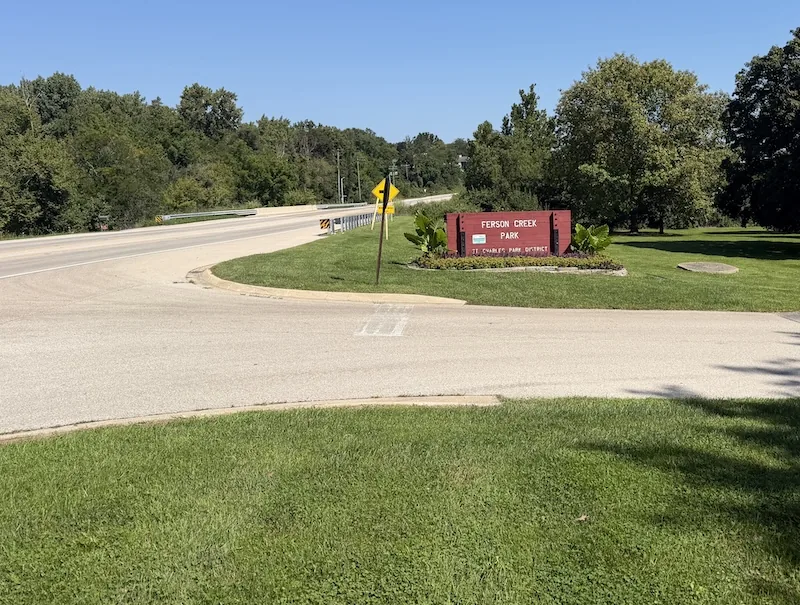
Ferson Creek Park is one of the easier places to put a kayak into the Fox River around St. Charles. There is no long carry, complicated ramp, busy marina, or question about where a paddler is supposed to go.
You pull into a small community park off Route 31, park within a short walk of the river, roll or carry the boat down a paved path, and launch from a small sandy shoreline beside the dock. That simplicity is the reason I use it so often.
Ferson is not the launch for every kind of boat. Vehicles with trailers are not permitted to park here, and someone looking for a conventional concrete boat ramp is better served at Boy Scout Park Boat Launch a few miles south. For a canoe, recreational kayak, or fishing kayak that can be carried or moved on a cart, however, very little gets between the parking lot and the water.
It is also worth understanding what Ferson is before arriving. This is a launch into the Fox River at Ferson Creek Park. The mouth of Ferson Creek happens to be beside it, but the creek itself is shallow, short, and not much of a paddling destination. The reason to launch here is the river.
Parking and Getting the Kayak to the River
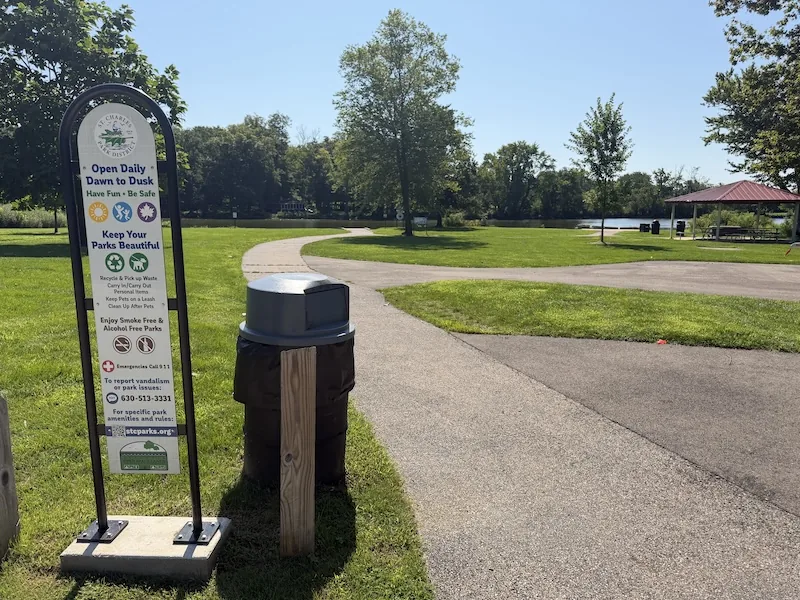
The parking lot is small but has never been a problem in normal use. Ferson is generally a lightly used park. The pavilion occasionally hosts a birthday party or family gathering, and there may be anglers along the shoreline, but it does not have the constant launch traffic of a developed motorboat ramp.
There is a designated canoe and kayak loading area immediately beside the paved walkway leading toward the river. I have never found much reason to use it. Regular parking is only about 50 feet away, and I have rarely seen anyone else bother with the loading space either.
For my Bonafide fishing kayak, I rig at the truck and use a kayak cart. The route from the parking lot to the river is paved and essentially flat, so even a heavier fishing kayak loaded with rods, tackle, battery, electronics, and the rest of the day's equipment is easy to move. There is no steep hill waiting at the end and no long stretch of soft ground to drag across.
That matters more with a fishing kayak than it does with a lightweight recreational boat. A carry that looks trivial on a park map can become irritating when the kayak itself weighs well over 80 pounds before the battery, fishing gear, motor, and everything else are added. Ferson avoids most of that problem.

Use the Beach, Not the Dock
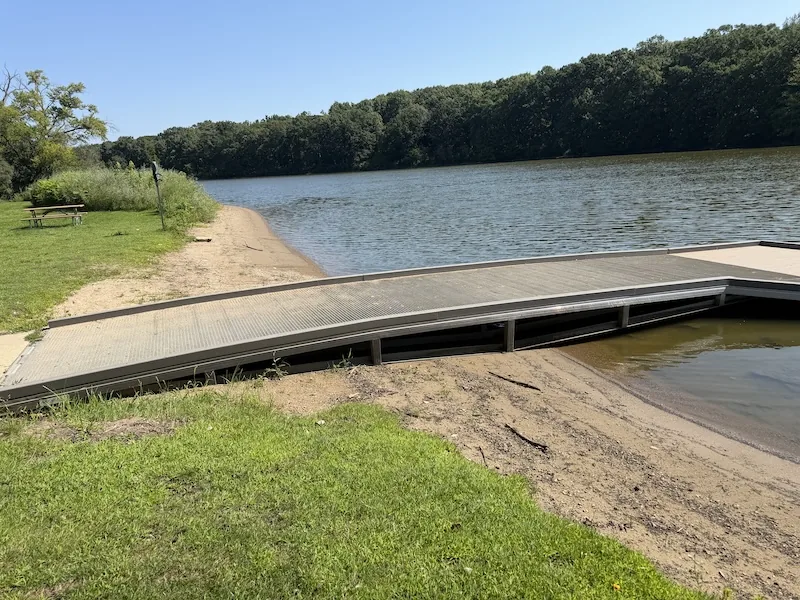
The obvious feature at the water is a floating dock. It is not where I launch.
Launching a kayak from a dock is awkward compared with simply walking the boat into shallow water, especially with a wide, stable fishing kayak. Immediately north of the dock is a small sandy beach, and that is where I put in. It is also where I have seen other canoe and kayak users launch.
The shoreline slopes gently into the river and has remained usable through every water level at which I have chosen to kayak here. At lower water, there is simply more exposed shoreline. As the river rises, the water moves farther up the same gradual approach rather than suddenly turning the launch into a difficult drop-off.
That gives you room to work.
My normal routine is to roll the fully rigged kayak down from the truck and place it half in and half out of the water. I unload the kayak cart and take it back to the truck. When I return, I attach the trolling motor, push the kayak farther into the river, and walk it out until I have enough depth to clear the motor blades. Depending on river level, that may mean standing in roughly knee-deep water before climbing aboard.
Coming home is the same process in reverse. I beach the kayak, remove the trolling motor, and carry the motor back with me when I retrieve the cart. Taking that weight off the stern makes the kayak a little easier to pull out of the softer sand. Then I load the cart and roll everything back to the truck.
None of that is a required technique for using Ferson. It is simply an example of how forgiving the launch is. A relatively heavy powered fishing kayak can be rigged at the vehicle, rolled to the water, launched from shore, and recovered without requiring a ramp or second person.
A Small Launch Shared by Several Kinds of Users
Ferson is a public park before it is a kayak launch, and the shoreline reflects that.
Bank anglers regularly fish around the launch area. Occasionally that means there are lines in the water precisely where a paddler would otherwise take the most direct route to shore. In my experience, this has never been much of a problem. The anglers have been conscientious about making room, and the same courtesy should run the other direction. A kayak does not confer an automatic right to force someone to reel in simply because the shortest line to the beach passes through where they are fishing. If I can go around a line without creating a problem, I go around it.
Powerboats require a little more attention. Ferson sits on a river used by both paddle craft and motorized boats, and some boats pass the launch faster than I would prefer. It does not take a large wake to complicate matters when a kayak is half floating, half grounded and the person launching it has one foot in the water. A passing wake can run directly onto the little beach and move the boat at exactly the wrong moment.
The solution is mostly patience. If a powerboat is approaching, I would rather wait a few seconds for its wake to reach shore than try to climb aboard while the water is moving underneath me. The same applies when landing.
There is one other piece of local knowledge that probably will not make the official launch description: wear shoes. Canada geese use the park heavily, and the grass and shoreline can accumulate plenty of goose droppings. Barefoot launching may sound pleasant in theory. Ferson provides several reasons to reconsider it.
The Dock, Boat Racks, and Park Facilities
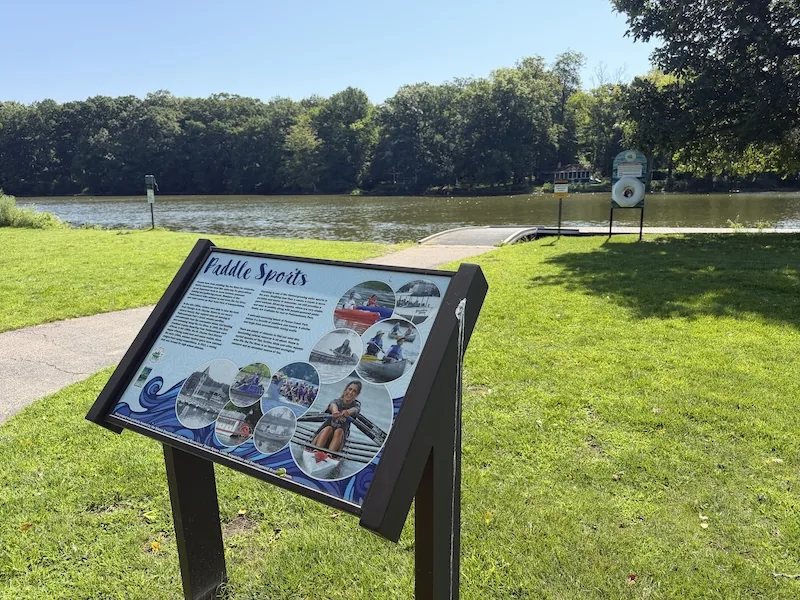
The floating dock is useful infrastructure even though I do not find it particularly useful for launching a kayak. It provides temporary access to the shoreline for boats already on the river and remains afloat as river level changes. Paddlers are free to use it, but the adjacent beach is simply easier.
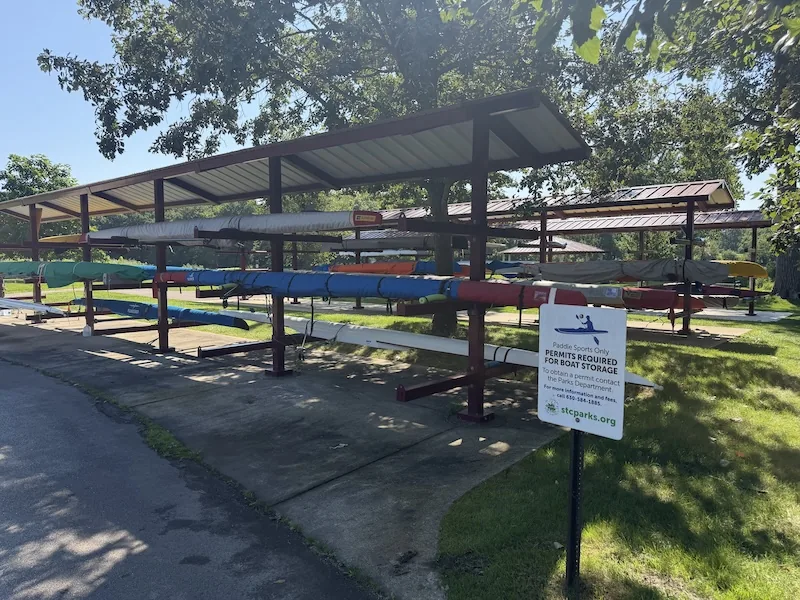
Boat-storage racks are also located near the water. Those racks should not be confused with the public launch itself. Storage requires a Park District permit; launching a canoe or kayak does not. Ferson Creek Park is a free paddlesports access point.
The park also has a pavilion, picnic tables, playground and flush restrooms. I have seen other visitors use the restrooms but have not needed them myself, and I bring my own drinking water rather than relying on whatever may be available at the park. The St. Charles Park District lists Ferson Creek Park as open from dawn to dusk.
The result is enough infrastructure to make the launch convenient without making the place feel like a developed marina. You can arrive, rig, use the river for several hours, and leave without dealing with a gatehouse, ramp queue or launch fee.
Where You Can Go From Ferson
Ferson's usefulness comes partly from where it sits in the St. Charles pool.
Heading north produces the longer trip. Red Gate Bridge lies upstream, with considerably more river beyond it for someone prepared to cover the distance. The official Fabulous Fox Water Trail measures 4.43 river miles between Ferson Creek Park and Jon J. Duerr Forest Preserve, which makes Ferson a useful takeout for a one-way downstream paddle from Jon Duerr as well as a starting point for an upstream out-and-back.
For an unpowered kayak, that distance deserves some thought. Wind and river current can turn the return leg into more work than the map suggests. For a powered fishing kayak, Ferson becomes particularly useful because the motor expands how much of the northern pool can reasonably be reached while still returning to the same vehicle.
Heading south is much shorter. Boy Scout Island is only about half a river mile downstream, and the river soon enters the more developed portion of the Fox River through St. Charles.
For someone unfamiliar with the area, my recommendation is simple: stop at the first bridge you reach when traveling south from Ferson and turn around there. The St. Charles low-head dam lies farther downstream. There is no reason for a first-time visitor using Ferson as an out-and-back launch to continue toward it.
That recommendation is intentionally conservative. A low-head dam is not something to discover from the cockpit after traveling downstream. Anyone planning to explore farther south should first understand the river, the dam, the available access points, and the appropriate safety margin.
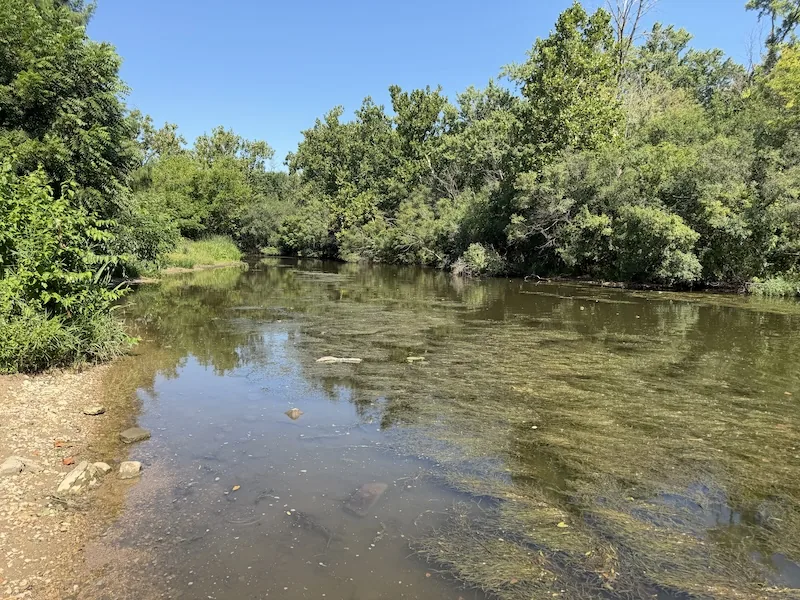
The other apparent route is Ferson Creek itself. There is not much reason to plan around it. The creek mouth sits beside the park and can be entered when water allows, but it becomes very shallow and does not extend far enough to make it a meaningful paddling trip.
Before Putting In
Ferson Creek Park does not require much technique to use well. Park close to the river. Move the kayak down the paved path. Use the sandy shoreline north of the dock. Watch for fishing lines and approaching boat wakes. Give yourself enough water to float whatever is hanging beneath the kayak before climbing aboard. Then remember that the easy launch is only the beginning of the trip.
Check river conditions rather than assuming the Fox looks the way it did the last time you were there. Know which direction you intend to travel and how much effort or battery reserve you need to get back. If you are heading south and do not already know the river below Ferson, use the first bridge as the turnaround. If you are heading north, recognize that the useful range grows quickly for a powered kayak but that every mile traveled upstream still has to be covered again on the return.
And when you come back, land on the same little patch of sand, pull the boat clear of the water, and roll it the short distance back to the truck.