
A bridge pylon is more than a piece of concrete in the river. Current splitting around it creates feeding lanes, protected water, depth changes, and several distinct places where fish can hold.
Bridge pylons are among the easiest pieces of river structure to find and some of the easiest to fish badly. The concrete is obvious, rising out of the river and offering the kind of precise target that practically demands a cast. Put a bait tight against the pylon, work the water immediately behind it, and move to the next one. Sometimes that works, but it reduces a surprisingly complicated piece of river to the least interesting thing about it.
The pylon matters because of what it does to the water. Current approaching its upstream face has to divide around the obstruction. Water slows immediately against the concrete, turns downward, accelerates around the sides, separates into a turbulent wake downstream, and eventually rejoins the larger river. Near the bottom, those forces can excavate sediment and create scour around the base. Add riprap, rubble, shade, a channel edge, or another pylon nearby and what appears from the surface to be a simple concrete column becomes a three-dimensional hydraulic system.
Learning to fish bridge pylons begins with learning to see that system.
Read the Water Before the Concrete
Start upstream and mentally follow the current. As the river approaches the pylon, water begins diverting before it actually reaches the concrete. A small area immediately against the upstream face experiences sharply reduced forward velocity while the surrounding flow is redirected toward the sides and some of it downward. Along the flanks, the river has less space through which to pass, so velocity increases. Downstream, those faster streams separate from the pylon and border the slower, turbulent water in its wake. Beneath all of this, the interaction between current and riverbed can create a depth change that is invisible from the surface.
Those zones do not have a fixed hierarchy. Their importance changes with discharge, depth, bottom composition, the shape and orientation of the pylon, and the geometry of the bridge itself. During weak flow, the hydraulic effects may become subtle enough that shade, depth, or physical cover matters more. As current increases, the side lanes and seams become more defined and the downstream refuge becomes more valuable. Push the river harder still and the comfortable holding water can collapse into surprisingly narrow strips along a seam, against the concrete, or farther into the wake.
This is where the familiar instruction to “fish behind the pylon” begins to break down. There is good reason anglers look downstream. Fish can hold in slower water there while remaining close to food moving past in the main current. But the protected backside is only one of several positions the structure creates, and it is not automatically the best one.
The upstream face is particularly easy to overlook. A fish positioned immediately against the nose of the pylon can occupy a small cushion of reduced forward velocity while remaining only inches or feet from water carrying forage toward it. Move slightly away from the concrete and the fish may suddenly be exposed to considerably stronger current, which helps explain why the useful position can be much smaller than it appears from the kayak. It also explains why an aggressive fish might choose the upstream side rather than the apparently easier water downstream: it gets an early opportunity at whatever the river delivers.
The lesson is not that the upstream face is secretly better than the downstream side. Replacing one rule with another would miss the point. The useful question is what the current is doing around this particular pylon under the conditions you are fishing.
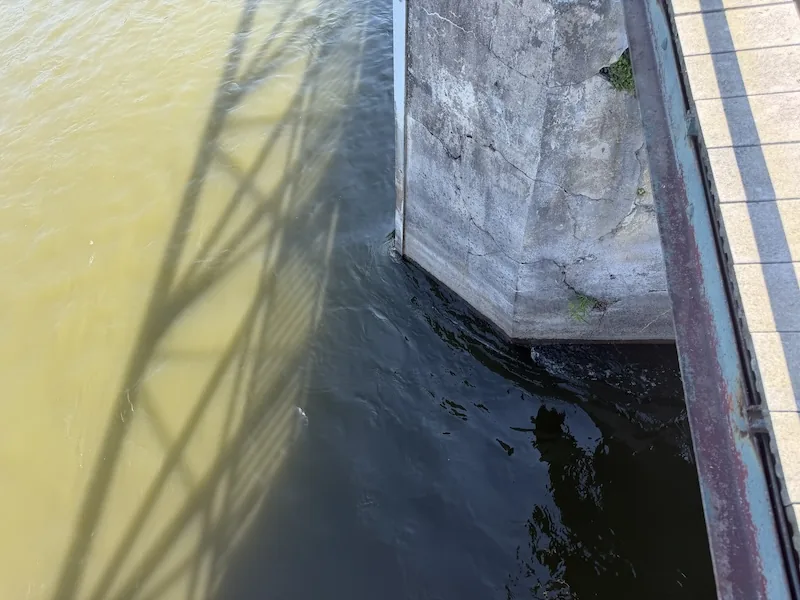
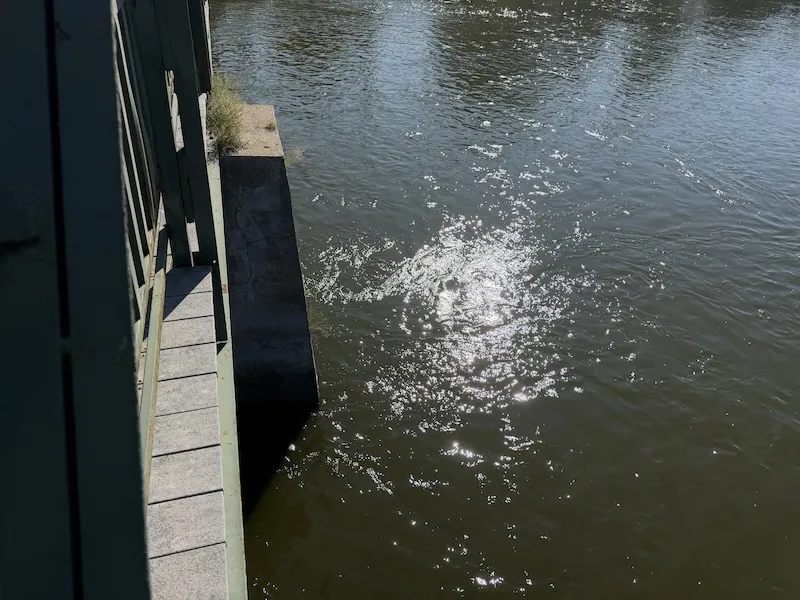
Photographs like these are less tidy than a hydraulic diagram, which is precisely why they are useful. The river does not draw clean boundaries around the upstream cushion, accelerated side flow, seam, and wake. Instead, those features appear as changes in texture, direction, speed, and turbulence that overlap one another. Comparing several views makes those changes easier to recognize because each angle emphasizes a different part of the same hydraulic system. The task is to learn which of those changes matters at a particular pylon on a particular day. Rather than choosing a casting angle because it points toward the concrete, choose one that allows the bait to enter the water you have identified and travel through it naturally.
Follow the Seams
Once the river divides around the pylon, the side currents often become the easiest part of the system to read. Water forced through the reduced opening accelerates along the flanks before separating downstream, and somewhere outside that faster lane it meets slower adjacent water. That boundary is the current seam, and for an angler it can be more important than the concrete that created it.
Sometimes the seam announces itself with a line of foam or floating debris, an abrupt change in surface texture, or two adjacent patches of water moving at noticeably different speeds. More often, especially when the surface is broken by wind, the transition is less obvious. The lure may reveal it first: a bait accelerates, the line begins to bow, or a bottom-contact presentation suddenly drags differently as it crosses from one velocity into another.
Those changes matter because the seam gives a fish access to food moving in the faster lane without requiring it to hold in the hardest current. The same energy tradeoff explains how current positions river bass around many other kinds of cover. The useful position may be only a narrow strip along that boundary, which makes presentation angle as important as casting accuracy. A bait thrown directly at the concrete can cross several different velocities before it ever reaches that strip, allowing the line to bow or the lure to accelerate away from the natural drift.
The better presentation is often to place the bait upstream of the target and let the river carry it into the productive water. Along a side seam, that can mean casting above the pylon and allowing the lure to sweep down the boundary rather than throwing directly across it. Weight becomes part of the current equation rather than simply a way to reach bottom. Too little and the bait races through the zone or never reaches the intended depth; too much and it becomes anchored while everything natural in the river continues moving downstream. The useful amount is whatever keeps the presentation in the current path long enough to look as though it belongs there.
The same thinking applies behind the pylon, where the common description of a quiet eddy can be misleading. The wake is not simply an oval of dead water tucked neatly behind the concrete. Flow separating from both sides produces turbulence, changing velocities, recirculating water, and boundaries where the wake meets the faster river moving past it. A bass can certainly use the slower water to conserve energy, especially as current increases, but the center of the calmest pocket is not necessarily the most interesting part. Often the useful position is closer to an edge, where a fish can remain protected while staying within striking distance of forage passing along the outside.
That turns the familiar instruction to cast behind the pylon into a more useful exercise. Find where the fast water meets the slow water, determine how that boundary is actually moving, and make the presentation fit it.
What You Cannot See From the Surface
Surface current explains only part of a bridge pylon. The bottom can be just as important, and it is where some conventional fishing explanations become too simple. Current does not merely wash out a convenient hole directly behind every pylon. Water striking the upstream face is driven downward toward the riverbed, where it contributes to a horseshoe-shaped vortex around the base. Flow also accelerates along the sides. Together those forces can remove sediment around the upstream nose and flanks and extend the resulting scour around the structure.
For an angler, the engineering distinction matters because the deepest water immediately associated with the pylon is not guaranteed to be directly downstream. Nor should every depression found near a bridge be interpreted as local pylon scour. The bridge opening may constrict the river as a whole. A natural channel may pass through one opening. Riprap may have been placed around a support. Construction debris, erosion, floods, and decades of changing flow can produce a bottom far more complicated than the visible bridge suggests.
A pylon that looks unremarkable above water can therefore sit beside a sharp depth transition, while another producing an impressive surface wake may stand on relatively uniform bottom. In deeper water, electronics make those differences much easier to identify. In a shallow river, the picture can emerge through a bottom-contact bait, a paddle or stake-out pole, visible rock, and accumulated experience at different river levels. However it is discovered, the useful information is the same: where current, depth, and cover overlap, the structure becomes more interesting.
Rock adds another layer when it is actually present. Riprap placed to protect a bridge support can introduce hard-bottom transitions, cracks, small deflection points, and dozens of miniature current breaks around the larger one created by the pylon. Rubble or old construction material can do something similar. But it should be discovered rather than assumed. Not every bridge support sits in a pile of productive rock, and treating an imagined rubble field as part of the structure is no better than assuming the deepest hole must be directly behind it.
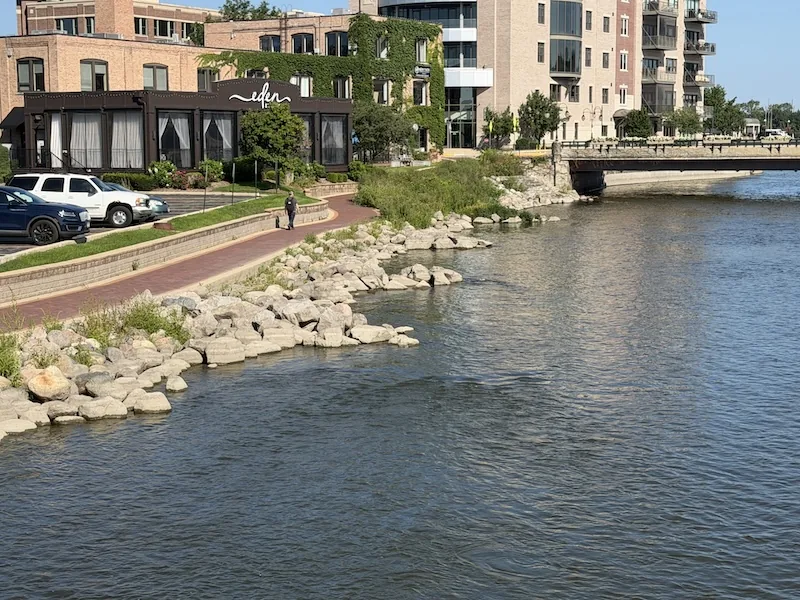
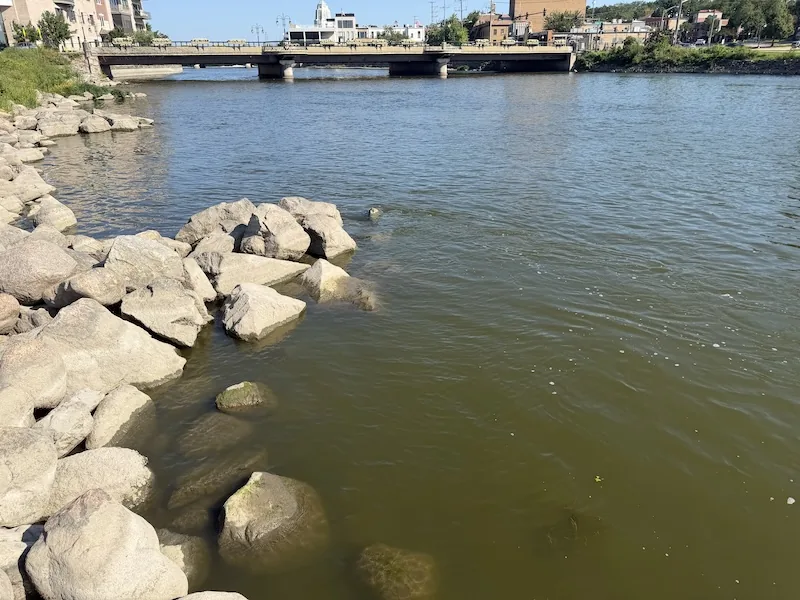
There is another dimension that a top-down view can obscure entirely. A bridge pylon extends through the water column, and on a deeper river the correct horizontal position may still leave an angler several feet away from the fish vertically. Bass can suspend alongside the concrete, hold near the lip of a scour depression, settle into rock near the bottom, or occupy a repeatable depth where current and forage intersect. The bridge deck can add a sharp shade boundary that becomes another ambush edge, sometimes independent of the most obvious current seam. On a shallow river with only a few feet of water, these vertical choices are compressed. At a bridge crossing a deeper channel, they can determine whether a seemingly perfect piece of structure produces anything at all.
Let the River Make the Presentation
Once the useful water has been identified, casting becomes a problem of trajectory rather than simply accuracy. A cast can land exactly where intended and still produce the wrong presentation if the current immediately carries the bait away from the holding position. Another can land several yards upstream of anything that looks interesting and become nearly perfect twenty seconds later as the river delivers the bait through a seam at the correct depth.
An upstream-face presentation should usually begin far enough above the structure that the lure arrives with the current rather than dropping directly onto the fish. A side-seam presentation can follow the boundary downstream instead of cutting immediately across it. Fishing the wake requires paying attention to the actual direction of recirculating water, which may carry a lure sideways or even briefly back toward the pylon despite the river moving downstream around it. Probing scour or a depth transition requires enough weight to reach the intended part of the water column without automatically pinning the bait to the bottom.
The lure still matters, but only after the water has defined the job. A bait that works beautifully along a slow seam may become impossible to control in accelerated side current, while a heavier presentation that reaches a scour lip cleanly may be completely wrong for a drift higher in the water column. Reading the route the current is already taking narrows the tackle decision considerably: choose a presentation that can enter that flow, reach the intended depth, and travel through the holding water without fighting the river.
That becomes more complicated once a bridge has several pylons, because each support does not necessarily operate as an isolated copy of the one beside it. The wake leaving one pylon can influence the water approaching another. A narrow gap can accelerate flow. One support may border the old river channel while another sits over a shallow flat. The outside pylon may receive relatively undisturbed current while an interior support receives water already redirected by the rest of the bridge. Debris accumulated against one support can alter its hydraulics without changing anything around the next.
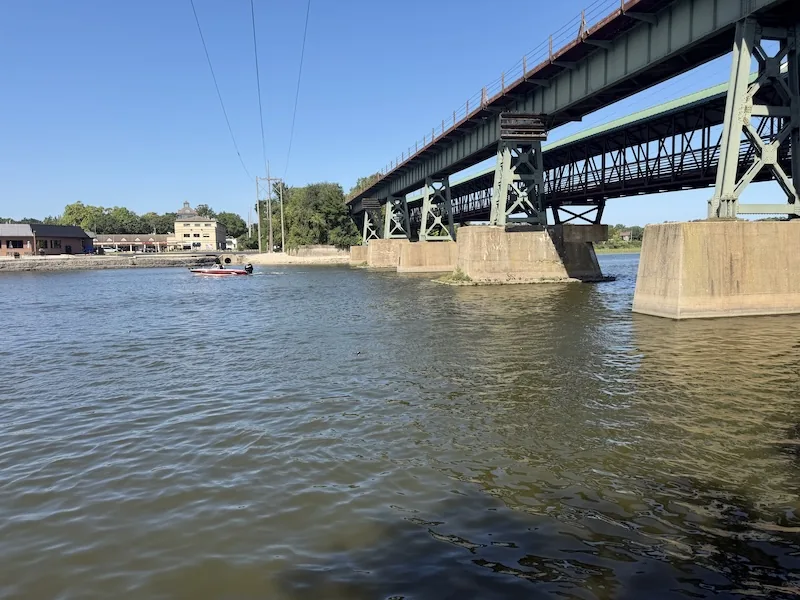
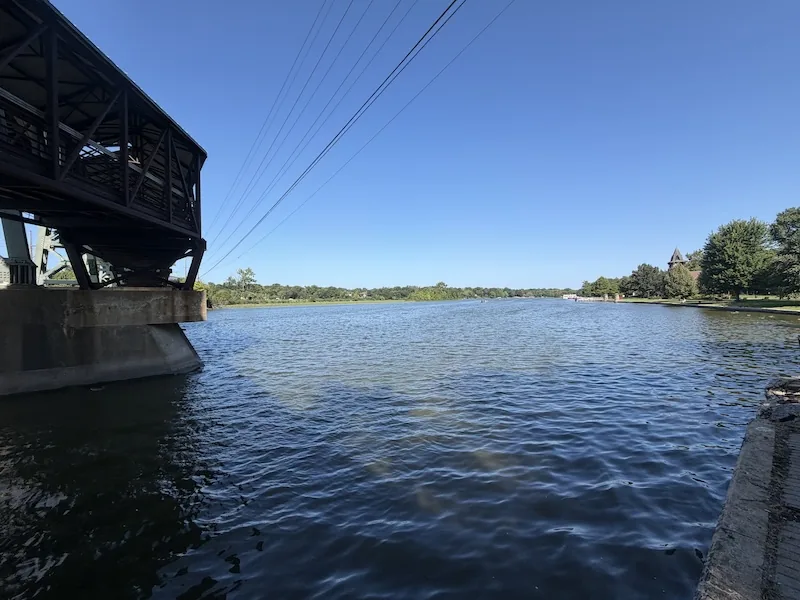
This is why catching a fish from the downstream side of one pylon should not immediately become a pattern of fishing every downstream face. The actual pattern may be that the productive support borders deeper water, carries stronger current, has rock at its base, creates the sharpest seam, or receives flow from a neighboring opening at a favorable angle. The fish may not be telling you to find another piece of concrete that looks the same. It may be telling you to find another piece of water that behaves the same.
Go Watch a Pylon Work
There is an easier way to learn all of this than trying to decipher it for the first time while controlling a kayak and making casts. Find a bridge where you can safely stand above the water and watch.
The pedestrian bridge across the Fox River just south of the St. Charles dam is unusually good for this. From the walkway, several pylons sit almost directly below you, close enough that the river can be studied from the same top-down perspective shown earlier in the article. You can watch the water approach a support, divide around it, change texture along the sides, and reorganize downstream without having to infer all of that from kayak level.
Start with a single pylon and ignore the others for a moment. Watch the water before it reaches the upstream face and look for the point where the flow begins separating. Follow one side downstream and compare its speed and surface texture with the water farther away. Look for foam, bubbles, leaves, or other debris tracing a seam. Then shift your attention behind the pylon and watch the wake long enough to see that it is not simply a stationary pocket of slack water. It pulses and circulates, and its edges are often easier to identify than its center.
Then move along the bridge and repeat the exercise at another support. This comparison may be more instructive than staring longer at the first one. Pylons that look nearly identical can produce noticeably different water because their position in the bridge, surrounding depth, neighboring supports, and approach current are different. One may develop a pronounced seam while another barely does. The wake behind one may be broad and obvious while another is distorted by flow arriving from the adjacent opening.
If conditions allow it, take another look at the same bridge when the river is substantially higher or lower. The concrete will not have moved, but the hydraulic map around it will have changed. Features that were obvious at one discharge may weaken, shift, or disappear at another. That comparison gets to the heart of why reading current is more useful than memorizing spots.
The value of this bridge is that the same water can look different depending on where you stand and how long you watch it. A single photograph may catch a seam or wake clearly, but the river is moving continuously. Foam lines stretch and disappear. Surface texture shifts with gusts of wind. A wake pulses rather than holding a perfect shape. Standing above the bridge long enough to watch those changes makes the still photographs easier to understand because you begin to see each one as a single instant within a moving system.
Fish the Water the Pylon Creates
Bridge pylons are useful teachers because the relationship between structure and current is unusually visible. You can see the obstruction, watch the river divide around it, identify changes in surface texture, and gradually connect those clues with depth and bottom structure you cannot see. Once those relationships become familiar, the concrete begins to fade from the mental picture. What remains are the upstream cushion, accelerated flanks, seams, wake boundaries, depth changes, rock, shade, and the interactions between one current and another.
That way of seeing the river carries well beyond bridges. Boulders split current. Laydowns redirect it. Island tips create seams and wakes. Vegetation edges separate different velocities. The geometry changes, but the underlying exercise does not: determine what the structure has done to the moving water, then look for the position that gives a fish the best combination of feeding opportunity, cover, and manageable current.
A bridge pylon makes that lesson unusually easy to observe because the cause is standing directly in front of you. The mistake is stopping there. The structure tells you where to look. The current tells you where to fish.