
Their hunting life unfolds in the narrow strip between land and water, where a small predator can disappear almost as quickly as it appears.
A mink sighting along the Fox River is usually over before you have sorted out what you were looking at. A dark shape slips between rocks, crosses a short stretch of water, climbs onto the bank, and disappears. There is rarely time for a careful look at the head or tail, and almost never the kind of prolonged view that makes identification easy. That brevity can make mink seem scarce, but the evidence points in another direction. American mink are established throughout the Fox River watershed and broader Fox Valley, and Illinois wildlife biologists consider them common across the state, with northeastern Illinois among the areas where they remain most abundant. They have been documented along the main Fox, in Kane County forest preserves, and in tributaries throughout the drainage.
Their habits explain why sightings are so poor. Mink spend much of their time close to cover, working the cluttered strip where bank, shallow water, roots, rocks, vegetation, and burrows overlap. A larger animal has to expose itself simply by moving through the same landscape. A mink can travel through it in fragments, appearing briefly in one gap and vanishing into another. A Kane County naturalist once watched one climb roughly fifteen feet up an oak tree, enter an active wood-duck nest box, and emerge after raiding the eggs inside. It is not the first place most people would picture a river mink, but it says more about the species than another account of how well it swims. The same animal can hunt crayfish beneath rocks, nose into a muskrat burrow, catch fish in shallow water, pursue mice along the bank, or climb after eggs when the opportunity is overhead.
A Weasel Built for the Riverbank
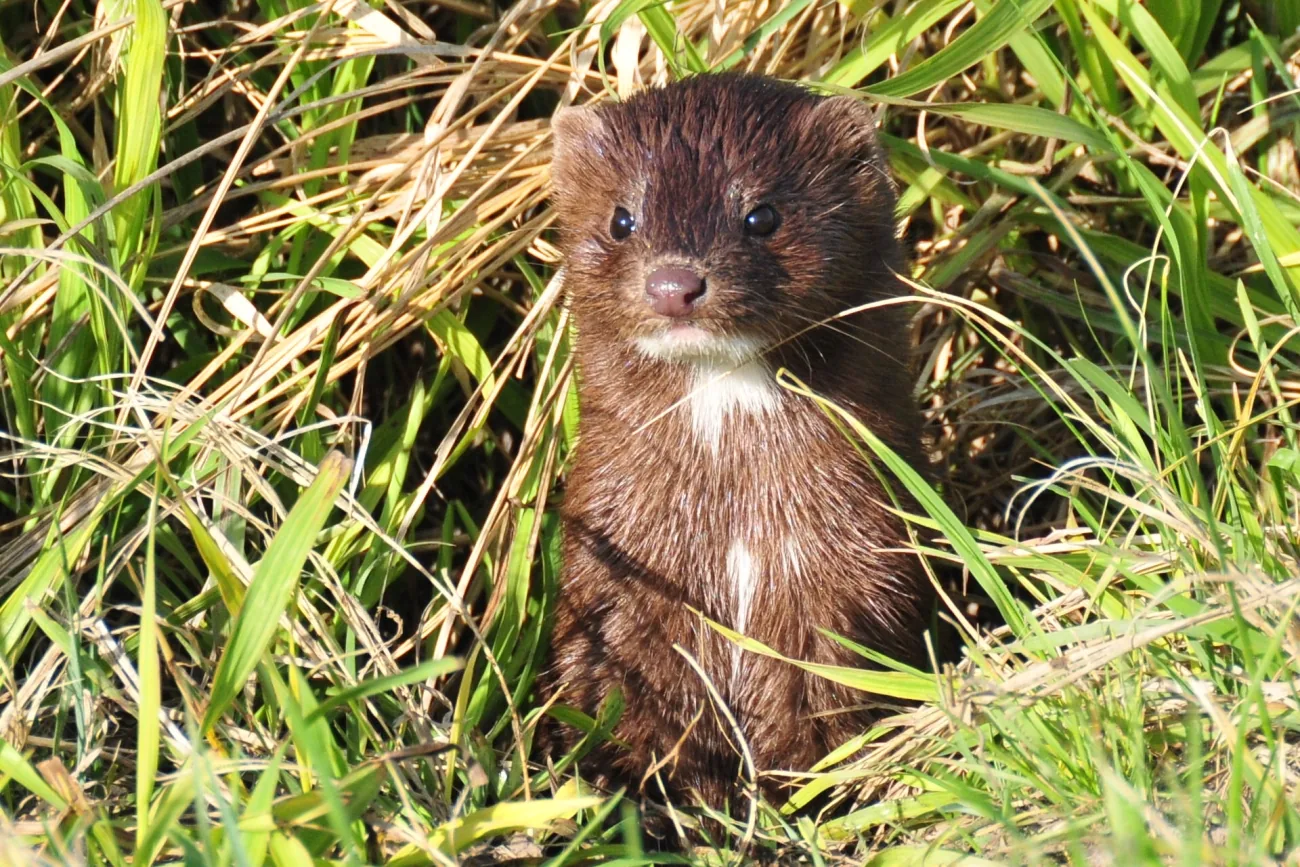
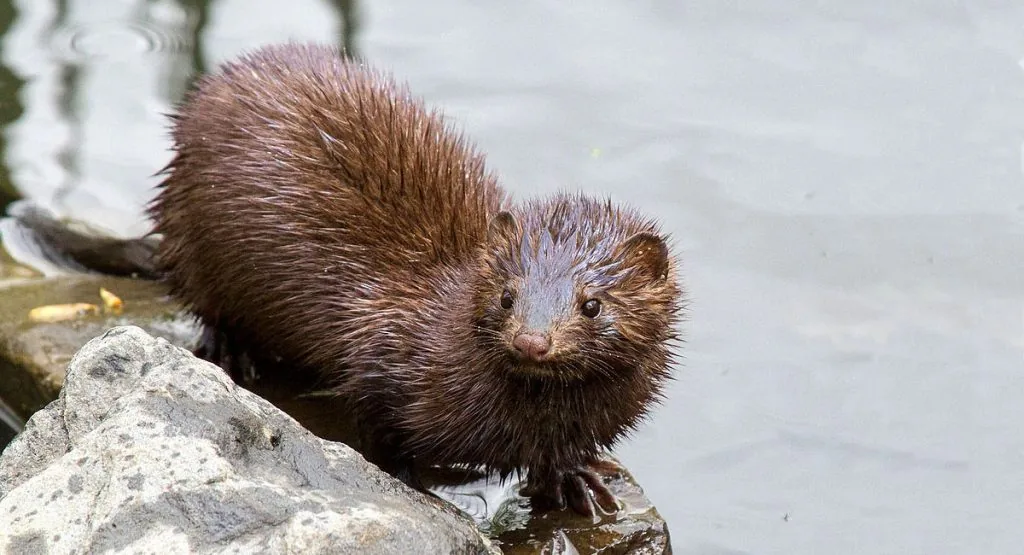
Once enough of the animal is visible, the family resemblance is obvious. A mink has the long, low body of a weasel, short legs, a narrow head, and a fully furred, tapered tail. Adults are usually somewhere around two feet from nose to tail, small enough to work into openings beneath roots, logs, and broken rock that would stop a larger predator. That body handles a shoreline well. A mink can run, climb, swim, dive, squeeze into cavities, and enter burrows made by other animals, shifting from one kind of movement to another without much delay.
A bank that seems fairly open from across the river may be full of places to disappear at close range. Undercut soil, root systems, woody debris, rock voids, and vegetation divide the shoreline into short sections of cover. Radio-tracking work in Illinois has shown home ranges stretched along waterways rather than spread broadly across the surrounding landscape. In one stream study, males used substantially longer reaches than females, averaging roughly 2.6 miles of stream compared with about 0.9 mile for females. Those figures do not describe Fox River mink specifically, but they show how strongly movement can follow the shape of the water.
Within that range, a mink may use several resting or den sites. Bank cavities, spaces beneath exposed roots, hollow logs, rock piles, brush, and abandoned muskrat burrows can all serve as shelter. That puts mink and muskrats into close contact. A muskrat may excavate a burrow and use it as part of a regular circuit of feeding and shelter sites; a mink can later occupy the same kind of structure, and Illinois telemetry work found mink responsible for most documented muskrat mortalities in one stream study.
Staying near water may also reduce some risks. Illinois telemetry work has found a disproportionate share of mink mortality away from streams, where roads, coyotes, and more exposed overland travel become part of the landscape. The shoreline is hardly safe, but it offers cover, escape routes, and food within a narrow corridor.
What a Mink Actually Eats
Because mink swim and dive, fish are easy to imagine as their main prey. Illinois diet work paints a broader picture. Researchers studying wild mink in east-central Illinois analyzed more than one hundred scat samples collected across several seasons and found that mammals and crayfish together accounted for more than 80 percent of total prey volume. Fish appeared often enough to matter, but represented only about 8 percent of the diet by volume across the study as a whole. Crayfish became especially important in summer, fish increased in winter, and mammals remained important throughout.
Mink adjust to what is abundant and reachable. If crayfish are concentrated and easy to take, they eat crayfish. If winter conditions make fish more available, fish become more important. Rodents remain part of the diet because the animal is still a weasel moving through bank cover, while frogs, insects, reptiles, birds, eggs, and other prey fill out the rest of the picture.
Another Illinois study looked at why mink used some stream reaches and ignored others. Researchers found that crayfish were distributed unevenly, with certain short stretches holding much higher concentrations than nearby water. Mink presence followed those prey hotspots more closely than several physical habitat characteristics researchers expected to be important. A stretch did not have to look especially promising from the bank. It had to produce food.
The wood-duck nest-box raid fits naturally into the same pattern. The mink did not leave its normal hunting strategy behind when it climbed the tree. It simply followed another opportunity.
More Swimmer Than Most Weasels, Less Swimmer Than an Otter
Mink are good swimmers and capable divers, though the phrase “semi-aquatic” can make them sound more committed to the water than many individuals actually are. Researchers who fitted wild mink with depth-recording devices found that the most common dives were modest, often around a foot deep and roughly ten seconds long. Deeper and longer dives happened, but they were not the normal pattern. The animals also differed dramatically from one another. Some made more than one hundred dives in a day; others barely dove.
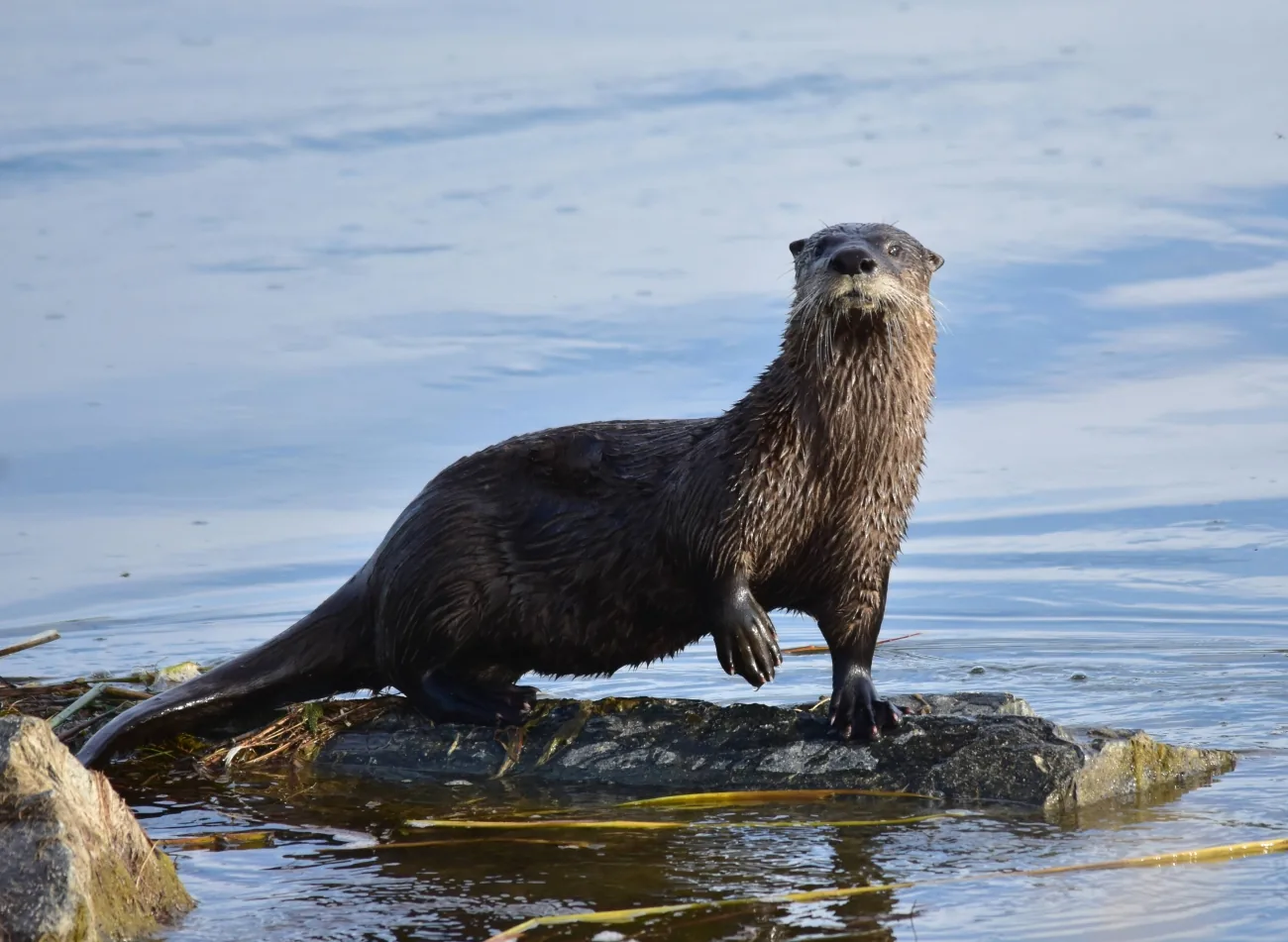
That variation shows how loosely the species is tied to any one hunting method. A mink can hunt underwater without building its entire feeding strategy around it. River otters are built around water to a much greater degree. They are larger, more powerful swimmers, capable of longer underwater travel, and their feeding ecology is more heavily tied to aquatic prey. Mink retain much more of the flexibility seen in other weasels. They climb, hunt small mammals, enter burrows, move through dense cover, and spend plenty of time on land beside the river.
Those differences affect what a person is likely to see. An otter may cross open water, surface several times, or travel far enough to stay in view. A mink can cover much of the same shoreline while remaining within a few feet of cover and appearing only in short flashes. It is not simply a scaled-down river otter.
Mink, Muskrat, Beaver, or Otter?
A brief sighting at the surface can make the Fox River’s semi-aquatic mammals surprisingly difficult to sort out. Size, body shape, tail, swimming posture, and behavior become useful when several clues agree.
| Comparison | Muskrat | Beaver | Mink | River otter |
|---|---|---|---|---|
| Image |
|
|
|
|
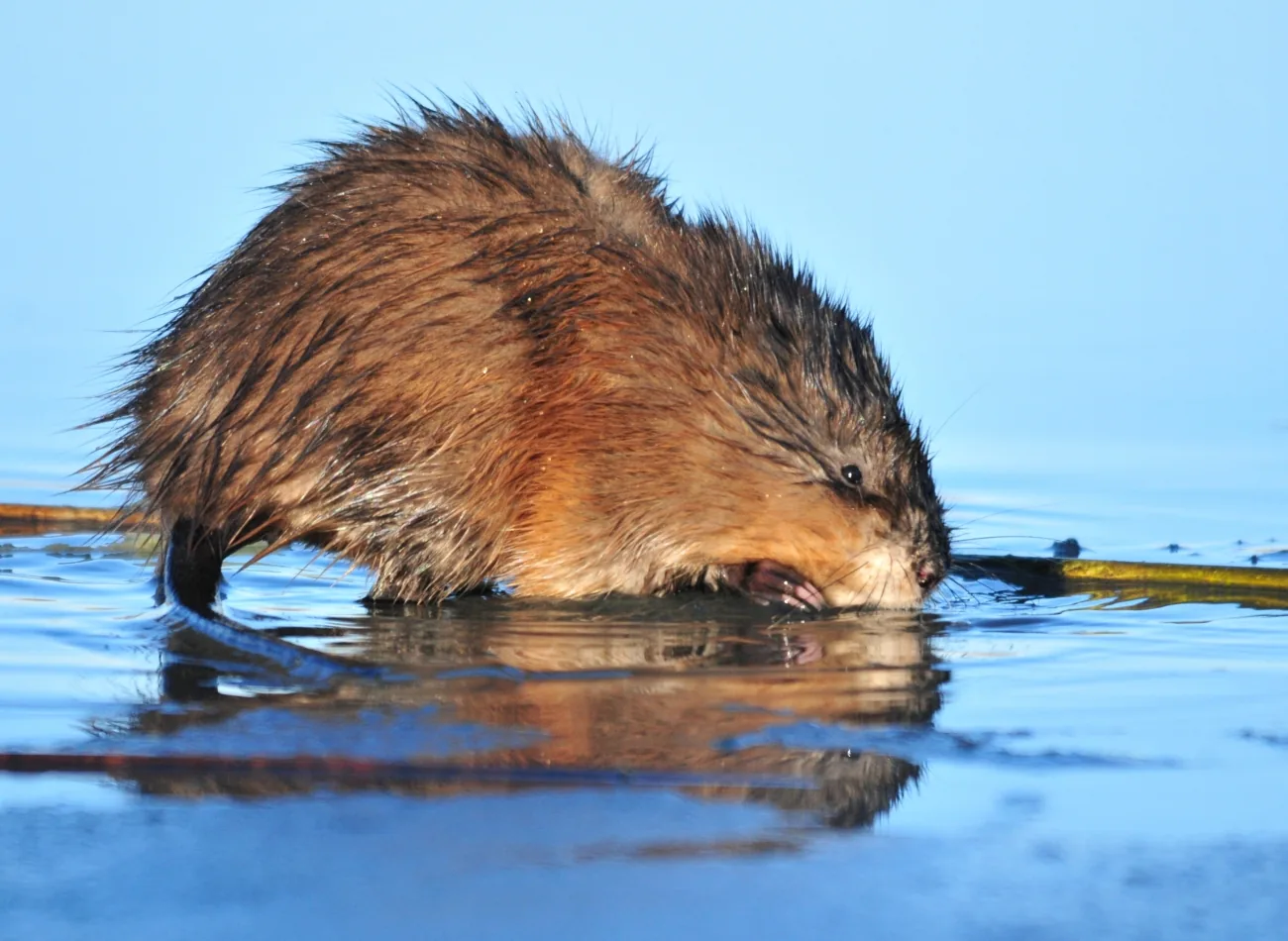
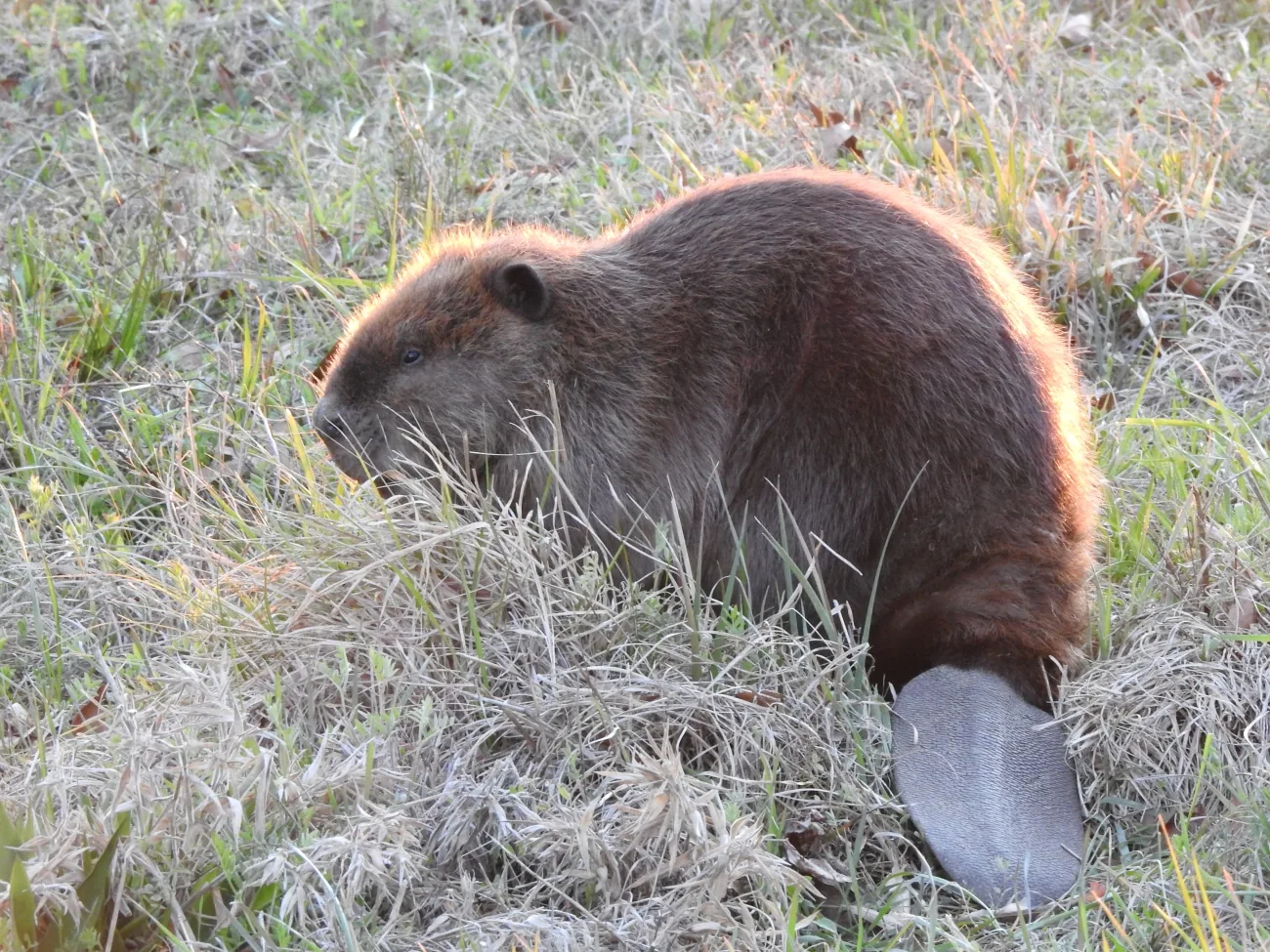
| Scale | About 18–25 in. total | About 3–3½ ft.; commonly 25–60 lb | Roughly 17–26 in. total | About 34–53 in.; 10–30 lb |
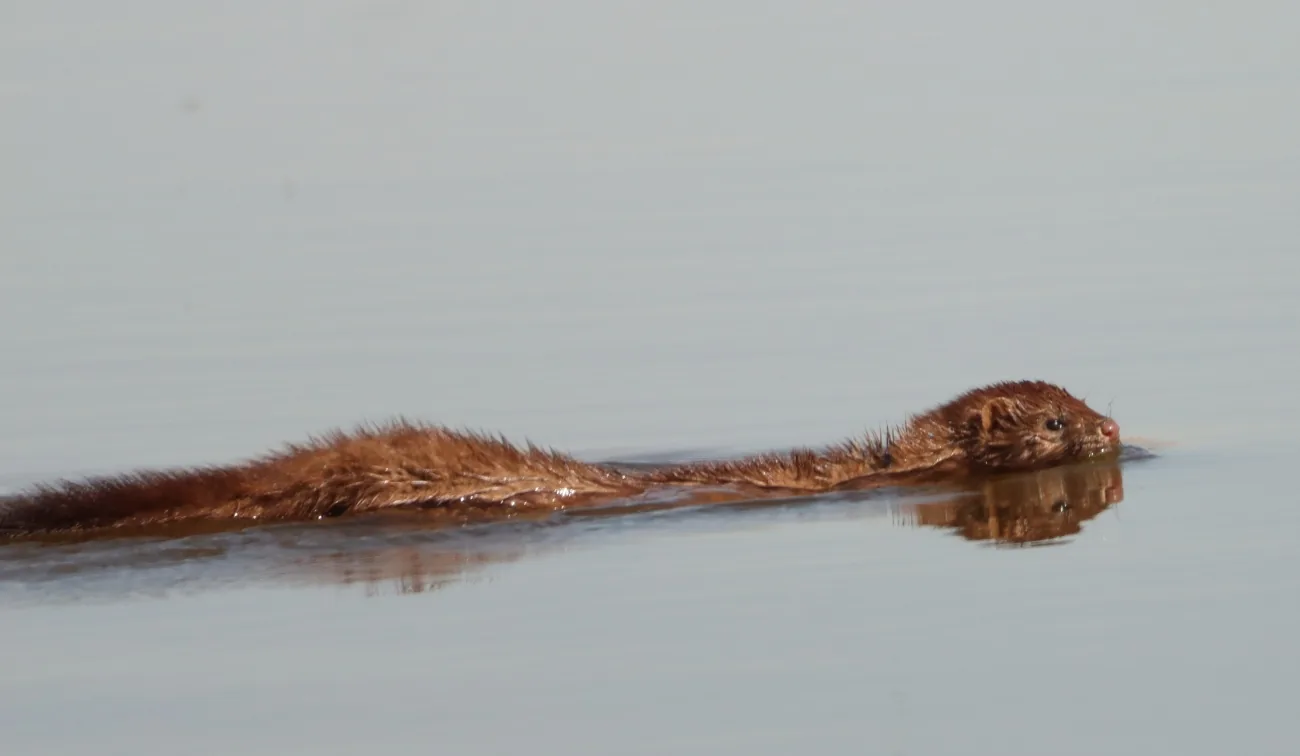
| Surface profile / swimming | Compact and rounded; the head looks large for the body. Often rides close to the surface near shore; part of the back may show depending on speed. | Much bulkier; the head looks relatively small on a heavy body. Smooth, low swim with more mass behind the head. | Long, low, weasel-shaped; often more of the back shows. Quick, direct swimmer that frequently moves in and out of shoreline cover. | Longer, heavier, thick-necked. Often the head and neck dominate at the surface, followed by repeated dives and long underwater runs. |
| Tail | Long, narrow, nearly hairless, and flattened side-to-side. May trail visibly or scull just under the surface. | Broad, flat, leathery paddle; often submerged while swimming, unmistakable when seen. | Fully furred, tapered, and darker toward the tip. | Thick, fully furred, muscular, tapering to the tip. |
| Behavior & context | Usually tight to bank, vegetation, sloughs, or backwaters. May carry plants and disappear into submerged bank entrances. | Chewed woody stems, slides, bank dens, dams, or lodges. Juveniles can confuse size at distance. | Hunts along rocks, roots, and banks; alternates readily between land and water. | More aquatic and wide-ranging; may surface well off bank or appear in pairs or family groups. |
With mink, behavior often helps as much as anatomy. A small, long-bodied animal that swims twenty feet, climbs onto rocks, disappears under roots, and then reappears farther down the shoreline is behaving very much like a mink, but you may see only one piece of that sequence. At distance, the animal can look like little more than dark fur, a small head, and a narrow disturbance on the surface. If it reaches cover before the body or tail becomes visible, there may not be enough information to make a confident identification.
A muskrat is more compact and tends to remain associated with feeding areas, vegetation, and submerged bank entrances. An otter is much larger and generally spends more time swimming and diving in open water. A beaver is larger again, with a body mass that becomes obvious once scale is clear. Wake shape can help a little, but current, chop, speed, viewing angle, and surfacing behavior can all change it, so body proportion, tail, posture, and behavior are more useful clues.
What Makes a Good Hunting Edge
There is no single Fox River shoreline. Some stretches run beneath mature trees with exposed roots hanging into the water. Others are armored with rock. Elsewhere there are wetlands, backwaters, tributary mouths, woody accumulations, shallow margins, islands, and developed riverfronts with little natural bank left. We do not have local telemetry showing that Fox Valley mink consistently prefer one of those shoreline types over another, so general mink biology can tell us what certain features may provide without turning the river into a simple habitat map.
Rocks can hold cavities and crayfish. Roots offer cover above and below the waterline. Woody debris creates shelter and can concentrate prey. Muskrat burrows provide underground space. Vegetation supports insects, frogs, rodents, and birds, while shallow margins allow access to aquatic prey without requiring long dives. A bank that looks perfect may not be productive, and a plain one may be full of food. The Illinois crayfish work is a useful reminder that prey concentration can matter more than outward appearance.
For a mink, the useful places are the ones where food and cover happen to overlap, and those are often the same places where an observer has the worst chance of getting a long look.
The Animal You Almost Never Get to Watch
Mink are not especially rare in the Fox Valley, but mink sightings are. A mink is small enough to disappear into shoreline structure, fast enough to cross open gaps quickly, and secretive enough to spend most of its time where there is little reason to expose itself. A beaver leaves chewed trees, slides, lodges, and other obvious evidence. A muskrat may make a steady crossing that lasts long enough to study. A river otter can surface repeatedly and travel a considerable distance in view. A mink may give you a few seconds and nothing more.
If a small, dark, long-bodied animal appears along the Fox, swims a short stretch, climbs out, and disappears into roots or rock, there may not be another chance to check the identification. You can spend a great deal of time beside the Fox River without ever seeing a mink clearly, and when one finally appears, there is a good chance the encounter will be over before you are ready for it.